Sunday, July 20, 2025

Review: An Inside Job

An Inside Job (Gabriel Allon, #25)An Inside Job by Daniel Silva
My rating: 4 of 5 stars

Allon is up to his old tricks with heists, forgeries, and restoration. The book is a good read, a fun summer thriller. However, it doesn't quite have the magic of earlier novels. Sometimes it feels like Silva has forgotten that Allon is Israeli and Jewish. There are like maybe four references to remind of us that; and nothing at all in the plot hinges on anything Israeli or Jewish. In the post October 7 world, I would have expect something from Allon about that. The other factor missing is there is little of Allon's inner thoughts and struggles. He's just a maestro orchestrating things as they unfold.

View all my reviews

Tuesday, July 15, 2025

Review: Before They Are Hanged

Before They Are Hanged (The First Law, #2)Before They Are Hanged by Joe Abercrombie
My rating: 5 of 5 stars

The second book in the First Law Trilogy picks up right where the first ends. While it has been over a year since I read the first book, it didn't take me long to step back into the world. There is a lot more action as the three central story lines set up in the first book come to fruition. The characters are further developed and more of the world is revealed. It continues to be a fresh, unpredictable, and well-crafted fantasy.

View all my reviews

Wednesday, July 09, 2025

Review: Judaism's Encounter with American Sports

Judaism's Encounter with American SportsJudaism's Encounter with American Sports by Jeffrey S. Gurock
My rating: 4 of 5 stars

An interesting way to look at the history of Jews in America. Gurock tells the story of how Jewish communities approached athletics from the earliest days up through the early 2000s. The first two chapters do also look at Jewish views of sport and athletics from ancient times up through the modern era. The focus is almost entirely on participation in sport, with only a bit here and there about Jewish fandom.

The main theme of the history is unsurprising: the tension between the pull of athletics and the religious laws. From ancient days to the twenty-first century: the main question is does participation in sports conflict with religious duties and if so, what to do about it. The different Jewish movements, orthodoxy, reform, etc., answer these questions differently. These differences, like in may other areas of American Jewry, leads to many intra-Jewish conflicts. The development and differences between the Y, the JCC, and the synagogue as Jewish communal centers was fascinating.

A secondary theme here is how sports participation becomes a marker of acceptance in American society. The negative view of this, from stricter corners of the orthodox world, is that it is a marker of assimilation and loss of Jewishness.

Overall, readable and interesting. Though at times, the minute details of the internecine battles between Yeshivas about how far to go with participation got a bit tedious.

View all my reviews

Thursday, June 12, 2025

Review: A Letter in the Scroll: Understanding Our Jewish Identity and Exploring the Legacy of the World's Oldest Religion

A Letter in the Scroll: Understanding Our Jewish Identity and Exploring the Legacy of the World's Oldest ReligionA Letter in the Scroll: Understanding Our Jewish Identity and Exploring the Legacy of the World's Oldest Religion by Jonathan Sacks
My rating: 5 of 5 stars

Rabbi Sacks is someone that I have for many years wanted to read. He’s written dozens of books about Judaism and religion, so it was always hard to know where to jump in. A Letter in the Scroll: Understanding Our Jewish Identity and Exploring the Legacy of the World's Oldest ReligionA Letter in the Scroll seemed to fit the bill. It is more personal and direct, not a weighty tome. Intended at first as a gift for his son on his wedding day, it is an attempt by Rabbi Sacks to answer central questions about Jewish identity. What does it mean to be Jewish? Why continue to be Jewish? Sacks' reply is both deeply personal and theological. To answer the question, Sacks retells the story of Judaism, its origins and developments through the millennia.

Sacks' discussion of faith and the nature of Judaism as a religion is, to me at least, novel. As Sacks argues, the faith of Judaism is not one of miracles and believing the irrational: it is as he puts it, more a call or a summons. It is a call to see the world as it is and to do something about it. He situates Jewish faith between a nihilism or cynicism that sees the world as it is but without a need to make it better and a utopian/mystical vision that rejects the world as it is for some other world. Judaism is of this world, this life: each of us must live in this world. For the believer, God created humans as the ones able to see the world as it is and how it ought to be, and that we are responsible for bridging the gap. This a compelling vision (and one that I think can secularized as well).

Sacks' discussion of the problem of evil or theodicy is quite interesting as well. In the face of the Holocaust, he says, we might reject the reality of God or the reality of evil. But if we reject the existence of evil, then Auschwitz is justified – at least from some unfathomable vantage point of God. On the other hand, Sacks argues, if we reject God for a blind, material universe then “there is no reason not to expect an Auschwitz” (180). Sacks says Jewish faith is the refusal take either horn of this dilemma: “each would allow us to live at peace with the world, and it is morally impossible to live at peace with a world that contains an Auschwitz” (180). Furthermore, Sacks argues, this world really is the only possible world or rather a world in which Auschwitz is a possibility is the inevitable result of God creating man. In many ways this is not a satisfying answer to the problem of evil (there are many ‘moves’ one could make here). But there is also something compelling about it: This is the world. It has tragedy and devastation. But it also has love, beauty and hope. We cannot ignore the former or let it overwhelm us; and we cannot forget the latter: we must live in the reality of both. Judaism, as Sacks casts is, is a way of doing just that.

The covenantal aspects of Judaism, as well as Sacks discussion of the dichotomies of the individual and the collective, the particular and the universal, were also very interesting. Though I am not capable of believing as Sacks does, I find much of what he says thought-provoking. It makes a kind of sense to me.

Sacks doesn’t see much future for Jewish life without the Jewish religion: I am more hopeful on that front. In part, I think a secular philosophy can provide justifications for the equal dignity and respect of all humans; the made in the image of the God is not the only way to get there. I do have some minor quibbles about Sacks comments about philosophy, and Spinoza in particular, but these don’t play major roles in the discussion and so do not ultimately detract from the book.

The central point of the book was an attempt to answer questions about Jewish Identity. Sacks gives his answer and there is much to commend in that: but I am not sure it fits with my view: both in the general answers one might give to these questions, but also with my own answers. I think Sacks would be okay with that. This is his answer and his answer made me think more about my own answer. I think that was, at least in part, one of his goals for the book.

For this interested in learning more about the uniqueness of Jewish theology, without having to wade into waters too deep, this is a good starting point.


View all my reviews

Tuesday, June 10, 2025

Review: The Missing Thread: A Women's History of the Ancient World

The Missing Thread: A Women's History of the Ancient WorldThe Missing Thread: A Women's History of the Ancient World by Daisy Dunn
My rating: 3 of 5 stars

I think the promise of this book is interesting: telling the history of the ancient Greek and Roman worlds with women at the center. I was hoping to learn about forgetten figures and thinkers; to find out about women that have been downplayed or ignored in the history. There is some of that, but this is more or less a retelling of ancient history. In that, it is compelling and Dunn tells the history well. But often the focus, particularly in the Roman period, is on the men and their wives or mistresses of these men. From there, we have speculation and extrapolation about their roles in history. There is also not a lot of focus on what life might have been like for woman more generally in these societies. In earlier periods, there is, unsurprisingly, a potentially confusing mix of stories, myths, and history. It is not always clear or obvious (at least immediately) what the sources are and how reliable or representative they are. There is a lot of speculation and extrapolation from thin data. While Dunn often does note this, it could be clearer.

The book is interesting and I enjoyed listening to it but it just doesn't deliver on the promise.

View all my reviews

Monday, May 19, 2025

Review: Eighteen Days in October: The Yom Kippur War and How It Created the Modern Middle East

Eighteen Days in October: The Yom Kippur War and How It Created the Modern Middle EastEighteen Days in October: The Yom Kippur War and How It Created the Modern Middle East by Uri Kaufman
My rating: 5 of 5 stars

An excellent account of how the Yom Kippur War started and unfolded. It is clearly and succinctly written. Dispassionate but still captivating.

The underlying theme of the war (and the book) is captured well by this quote: “Fortunately for the Israelis, the Egyptian leadership would match their dysfunction and overtake it” (255). Israel’s overconfidence after 67 and the infamous ‘Conceptzia' led them to miss the signs of the coming war; and then early on there were many strategic and tactical errors. Nonetheless, the Israelis often got lucky in their mistakes. Though the Egyptians had the element of surprise, fought well, and had the advantage early on; they too seemed to get overconfident and made errors that ended up being more disastrous for them Israel’s errors were for Israel. And after a few days, the Israelis were able to get back the upper hand. By the end of the war, they could have destroyed the Egyptian Army and marched on Damascus. The book focuses much more on the war with Egypt rather than Syria. Kaufman does discuss the war in the north, but its significance was less. Like Egypt, Syria made surprising early gains, only to have these quickly reversed. But the fighting and consequences of the fighting along the Suez is what, as the subtitle of the book says, “created the Modern Middle East.” It is there that Egypt and Israel nearly brought the Soviets and the Americans into war but also to the eventual peace between Egypt and Israel.

The last chapter of the book discusses some of the longer term consequences. It does not go into any great detail about Camp David and the peace talks and treaty. But Kaufman does discuss the Agranat Commission that looked into the government's and army's early failures. Interestingly, Kaufman's view of the commission is that it was more scapegoat that an honest attribution of responsibility. That was new to me -- the commission is now held up as something so important and key for postwar Israel and that Israel needs as similar commission now. But if Kaufman is right, maybe not. Kaufman argues that in the years since the war and the commission, Golda, Dayan, and Elazar all end up with reputations that are unfairly tarnished. He expresses hope that in the future people can see how their contributions during the war, while far from perfect, where central in saving Israel from disaster and turning near defeat into victory.

This was not the resounding victory if 67. 73 was very nearly a total disaster. How close Israel got to actually using nuclear weapons is not clear, though Kaufman does show that there really were discussions. Israel was able to hang on and turn the tables but it really shouldn’t have been in the position it was in. In this way, Kaufman’s account mirrors so much of what happened 50 years later, almost to the day, on October 7, 2023. Israel’s overconfidence, it’s reliance on technology, its unrealistic sense of understanding the motives of its enemies, led it disaster – one in many ways worse than 73. Both were avoidable with leadership that didn't fall into the same traps.

The 73 war is another case study in the adage of armies preparing to fight the last war. Israel was prepared to fight a war like 67; but Sadat and Egypt presented them with different challenges. They had weapons, like the Saggers and SAMs, that they didn’t have or weren’t employed well in 67. And they had the element of surprise. Israel, though, quickly learned lessons on the battlefield as it fought to help it fight better and win the war. And much like the start of the war, we see something similar in Gaza today as the IDF learned how to fight this war as it fought it. The optimist in me hopes that Israel can, like in 73, achieve a victory that brings a peace to the region -- much like the victory of 73 helped to bring peace between Israel and Egypt.


View all my reviews

Thursday, May 15, 2025

Review: Zion's Fiction: A Treasury of Israeli Speculative Literature

Zion's Fiction: A Treasury of Israeli Speculative LiteratureZion's Fiction: A Treasury of Israeli Speculative Literature by Sheldon Teitelbaum
My rating: 4 of 5 stars

A fascinating collection of stories. The stories are quite varied; though there are two things that I felt ran throw them all. The first is that the default background was Jewish. This is hard to define or pinpoint exactly, but there was something just, well, Jewish about the stories. Sometimes it was explicit but other times, it was more just something there. The second thing is that almost all the stories, if not all, were a bit dark. As though one could sense a kind of underling traumatic or tragic in each one. Some were funny or sweet, but even in those there was some thing lurking underneath. Maybe these are really two sides of the same thing; but it is interesting that this collection of stories all seemed to have that element. Maybe this is the genre, or maybe it's the editors.

I think it's important to pay more attention to the "speculative literature" part of the title rather than the "Zion's fiction." The latter suggests science fiction, while speculative captures a broader range of stories: including science fiction, but also fantasy and horror. There are no bright lines between these genres, but there are certainly paradigmatic versions of each. In any case, these stories were all mixed, maybe a bit more heavy into the fantastical and horror elements. Only a few could be categorized as "pure" science fiction (if there is such a thing).

I'd probably prefer something more science-fiction-y and less fantasy/horror; but I still was interested in all the stories.

View all my reviews

Wednesday, May 14, 2025

Review: Robert B. Parker's Revenge Tour

Robert B. Parker's Revenge Tour (Sunny Randall #10)Robert B. Parker's Revenge Tour by Mike Lupica
My rating: 5 of 5 stars

This was fun; a few surprises that fans of the Spenser-verse will enjoy. The plot was a bit unfocused, several elements that didn't have a payoff and confused things. Maybe these were meant as red-herrings, but if so they weren't well executed. Lupica has a good feel for Parker's characters and can emulate the witty repartee, but Parker's plot were tighter and more focused. Still I enjoyed it.

Two quibbles: I am not sure how this plays if reading it, but listening to it there were too many "he said"s and "I said"s in the dialogue. It was distracting in the audio. Overall, I like the narrator, though there was some uptalk that could be distracting.

View all my reviews

Saturday, May 10, 2025

Review: Morning After the Revolution: Dispatches from the Wrong Side of History

Morning After the Revolution: Dispatches from the Wrong Side of HistoryMorning After the Revolution: Dispatches from the Wrong Side of History by Nellie Bowles
My rating: 5 of 5 stars

An interesting look back at when the world went bat-shit crazy for a few years. Bowles has an interesting perspective as a former reporter at the NYT and self-described San Francisco progressive. She was an insider of sorts and as a journalist is able to approach her our journey through this craziness as a reporter would. It makes it a personal story without being overly so: she's covering herself and her journey.

There isn't any thing too deep here: Bowles is not digging into the philosophic or psychological ideas or motivations: she is reporting on them. She is reminding us of what the cadre of media and academic elites said and did at the time. This is important as people forget or smooth out what happened to seem less scary or crazy. Bowles reminds us that people really did say and mean defund the police. There really were people on the progressive left that pushed (and still do push ) racist "antiracist" ideas. And so on through gender, education, COVID polices, housing and homeless, prosecution.

Bowles started out in those camps, but slowly over time, reality pushed back and made her question a lot of what was being said and done. Some might say she's red-pilled or whatever, but she still seems to hold many of the same traditionally progressive views points but in more moderate and centrist ways. It's telling that a move to middle is regarded as something radical.


View all my reviews

Tuesday, May 06, 2025

Review: Robert B. Parker's Payback

Robert B. Parker's Payback (Sunny Randall #9)Robert B. Parker's Payback by Mike Lupica
My rating: 5 of 5 stars

As always, I love being back in the Spenser-verse. Lupica does a good imitation job and I enjoyed reading it. There are definitely some choices he makes that I don't think Parker would have, but the flow of the plot, the wit of the characters, and the dialogue are Parker-esque, or close enough.


View all my reviews

Friday, May 02, 2025

Review: SuperBetter: A Revolutionary Approach to Getting Stronger, Happier, Braver and More Resilient -Powered by the Science of Games

SuperBetter: A Revolutionary Approach to Getting Stronger, Happier, Braver and More Resilient -Powered by the Science of GamesSuperBetter: A Revolutionary Approach to Getting Stronger, Happier, Braver and More Resilient -Powered by the Science of Games by Jane McGonigal
My rating: 4 of 5 stars

I really enjoyed and got a lot of the first part of the book where McGonigal discusses the psychology and philosophy behind games and the connections to our lives. Part 2 is practically focused discussing various ways to implement and use the approach. It's the self-help portion of the book. Part 3 are more detailed listings of quests one can do. I didn't listen to the latter (not really conducive to an audio book).

Parts 2 and 3 don't really work well for the audiobook, though I think quests and methods can be helpful. What's revolutionary about the approach is the process, not the ideas. It's a lot of ways to help tap into one's social network and inner strengths. Psychological, not a lot a new here. But the use of game-like behaviors and structures can be very helpful.

I plan to dig deeper into the scientific literature McGonigal includes; I think there is a lot to the connection between how we play games and how we can approach living our lives.


View all my reviews

Friday, April 25, 2025

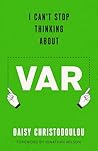
Review: I Can't Stop Thinking About Var: Forward by Jonathan Wilson

I Can't Stop Thinking About Var: Forward by Jonathan WilsonI Can't Stop Thinking About Var: Forward by Jonathan Wilson by Daisy Christodoulou
My rating: 5 of 5 stars

This is primarily a book about VAR (Video Assistant Referee), its problems, and some ways to think about possible improvements. But there is an undercurrent of some deeper themes about the natural and limits of rule-governed orders and how to make sure they function well towards their aims.

It is a quick read, with many interesting ideas and analyses of VAR. The author discusses the way VAR has affected the rules and the games. She explores the why of these changes as well. She discusses how VAR might be improved, but also the limits to any such improvement. The writing is smooth and interesting.

It’s worth reading for anything interested in football, but also for those interested in the philosophy of sport. There isn’t any reference to the philosophical literature on these issues, but it’s not really about the higher-order questions here: it’s more practically focused. That said, the things she covers have relevance for those philosophical questions, the philosophy has relevance for the issues she is looking at.


View all my reviews

Monday, April 14, 2025

Review: Temptation of the Force

Temptation of the Force (Star Wars: The High Republic)Temptation of the Force by Tessa Gratton
My rating: 5 of 5 stars

This is one of the better HR books. I felt like a got a clearer picture of the characters than in some of the other HR novels. The story cooks along with a good mix of personal scenes, dialogue, and battle scenes. The only downside is that there is little revealed; much, I hope, will be answered in the sequel. There is one significant occurrence in the novel, that as far as I know, is unique. No spoilers! The narration is great.

View all my reviews

Tuesday, April 08, 2025

Review: The Auschwitz Violinist

The Auschwitz Violinist (Adam Lapid Mysteries, #3)The Auschwitz Violinist by Jonathan Dunsky
My rating: 5 of 5 stars

This is the third novel in the wonderful series that follows an Israeli hard-boiled detective in Tel Aviv in the late 40s and 50s. This one is set in 1950. Adam is following up on a suicide of a fellow Auschwitz survivor; as you might expect--there's more to this than the police think. He's also preparing to go on private vengeance mission to kill Nazis still in Germany. The story plays with ideas of vengeance and justice; desert and guilt, surviving and moving on. It also explores the complicated perception of survivors in Israel. Highly Recommend!

View all my reviews

Friday, April 04, 2025

Review: Pronoun Trouble: The Story of Us in Seven Little Words

Pronoun Trouble: The Story of Us in Seven Little WordsPronoun Trouble: The Story of Us in Seven Little Words by John McWhorter
My rating: 5 of 5 stars

An absolute delight. McWhorter's way of presenting linguistics and language evolution is clear, entertaining, and persuasive. Grammar pedants might be put off by some of his conclusions: about "Billy and me" and the singular They, in particular, but he's too reasonable and careful in his argumentation to easily reject him.

My only objection is how short it is, I would have like a few more chapters.


View all my reviews

Monday, March 31, 2025

Review: Robert B. Parker's The Devil Wins

Robert B. Parker's The Devil WinsRobert B. Parker's The Devil Wins by Reed Farrel Coleman
My rating: 5 of 5 stars

Coleman's version of Stone is very good. Its bit grittier than Parker's, but still captures the characters and town that Parker created. The mystery is well put together and we learn more about some of the main secondary characters.

The narrator is excellent and does a good job differentiating between the voices.

View all my reviews

Sunday, March 30, 2025

Review: Titan Song

Titan Song (The Carter Archives, #3)Titan Song by Dan Stout
My rating: 4 of 5 stars

This series is fascinating in terms of the underlying mythology of the world. I am intrigued by various mysteries about magic, the origins of the different species, what is really under the city. The story has lots of action and some good humor. That said, I didn't love it. It sometimes tries a bit too hard to be noir and gritty. At times it falls into the 'telling instead of showing' trap. There was a bit too much self-righteousness about the downtrodden and the grasping rich and powerful. That gets a bit trite and repetitive after awhile. It's not unimportant for the story, but that's where the show me don't tell me comes in.

Still, if there was a book 4, I'd read it.

View all my reviews

Friday, March 21, 2025

Review: And There Was Light: Abraham Lincoln and the American Struggle

And There Was Light: Abraham Lincoln and the American StruggleAnd There Was Light: Abraham Lincoln and the American Struggle by Jon Meacham
My rating: 5 of 5 stars

This is one of the best biographies I've ever read. Meacham captures the life, spirit, and times of Lincoln in a near perfect balance. It is not so detailed that one is overwhelmed, nor lacking in appropriate levels of depth. One aspect I really liked was how he weaves together so much of the story through newspaper accounts, speeches, letters, and other comments from contemporaneous stories. This gave the account a greater authenticity, as well as better capturing the changes in perspective of Lincoln himself and of Lincoln by others. Meacham presents an objective, clear-eyed view of Lincoln: a great and good man with many flaws. (Maybe much like the country he led and continues to inspire?)

The slow, prodding movement of Lincoln towards emancipation and equality is one of the main themes. Lincoln was always anti-slavery. But over time, his views about how to bring about its end and what to do after the ending of slavery evolved more and more. At first, he thought limiting slavery to the South, preventing its expansion would slowly kill it. But by the civil war and its end, it became clear to him that slavery had to be killed directly and immediately. At first, he was a proponent of colonialism: the emigration and resettlement of the freed black population somewhere outside the border of the US, Lincoln came to see that this wouldn't work and there was a need to come to grips with a multi-racial society--one where blacks would be equal participants in the political process. Lincoln seem to hold many of the conventional and common racist views of his day, but again over time, he sheds those views. Lincoln, in his own person, shows the way to moral growth.

Lincoln was a politician but also a statesman: a man with political ambitions, but always guided by a strong moral compass and clear set of principles. He had a grand vision for liberty and equality but knew that he couldn't merely impose it; that it had to be more gradual and incremental; that he needed to bring the country along as he had been brought along to the view of equality. This was frustrating to some of his contemporaries, like Fredrick Douglass, Charles Sumner, and Elizabeth Cady Stanton who wanted to move faster and more immediately. In retrospective, Lincoln's incremental, slow movement looks more effective. But one never knows.

The counterfactual of the direction of America, in reconstruction and beyond, had Lincoln lived is one of the most intriguing. Meacham doesn't delve into this too much -- though the discussion of Johnson and his reversals after Lincoln's murder strongly suggests that had Lincoln lived, reconstruction would have proceeded with the moral vision of equality and liberty for all. We might have avoided the Black Codes and Jim Crow. What untold greatness of America did we miss out on because Lincoln did not live to guide that vision?

I cannot recommend this book highly enough; it should be required reading in every US high school.


View all my reviews

Thursday, March 20, 2025

Review: Ayn Rand: Writing a Gospel of Success

Ayn Rand: Writing a Gospel of Success (Jewish Lives)Ayn Rand: Writing a Gospel of Success by Alexandra Popoff
My rating: 3 of 5 stars

This is a decent biography of Rand: it covers the main points of her life in concise and clear ways. Popoff tries to be balanced and fair to Rand; she includes points of view from critics and followers alike. There are only a few slips of snide remarks that make there way in to the book. The book is its best and most interesting when recreating from letters Rand's life in Russia and her early days in the US.

The discussion of Rand's ideas are superficial and often muddled: Popoff is not a philosopher and is a bit of her depth here. The discussions of Rand's fiction is better, though predictably falls into the all too common (but unwarranted) criticisms of wooden characters that are only symbols.

Given that this was part of the Jewish Lives series and the suggestion on the back cover of discussion of the Jewishness of her characters, I was really interested to see what was said about Rand, her Jewishness, and the Jewishness of her characters and work. However, this was rather disappointing. There just wasn't a lot here. In the first part of the book, her life in Russia and her family, there is more discussed -- though this often more suggestion and speculation than substantive connections. As for Rand's character, fiction, and philosophy and what might have been Jewish about that, there is little that wasn't superficial or speculation.


View all my reviews

Saturday, March 08, 2025

Review: Goyhood

GoyhoodGoyhood by Reuven Fenton
My rating: 4 of 5 stars

A really interesting read. Two estranged twin brothers reconnect with each other -- and with themselves over grief, loneliness, and having their worlds flipped upside down. It is funny, poignant, and, at times, outlandish.

Mayer could be a bit of dolt at times; his attitude about certain things could be frustrating, even disturbing. But he's also ignorant of the world outside of his community and in that way has a child-like innocence. David could be a bit of a caricature, but becomes more interesting as the book goes on. Charlayne is a well-developed character that really helps to humanize the boys; and can't leave out Popeye!


View all my reviews

Thursday, March 06, 2025

Review: To Be a Jew Today: A New Guide to God, Israel, and the Jewish People

To Be a Jew Today: A New Guide to God, Israel, and the Jewish PeopleTo Be a Jew Today: A New Guide to God, Israel, and the Jewish People by Noah Feldman
My rating: 4 of 5 stars

The book starts with the question “What’s the point of being a Jew?” The book is not really an attempt to answer that specifically; instead it focuses more on trying to make sense of being a Jew; especially today. In particular, as the first line of the last chapter asks, “Is there a way to be Jewish today that brings together God, Israel, and Jewish peoplehood and that is available to Jews with very different conceptions of all three?” It’s an intriguing question and Feldman doesn’t really offer a straightforward answer – and is unapologetic about that. There isn’t and really couldn’t be a straightforward answer here.

In the end, the answer is more or less that part of the essence of being Jewish involves struggle (as is rooted in the biblical renaming of Jacob to Israel). The struggles are multivariant: struggle with God, with one’s self, with other Jews, with non-Jews, etc. Being Jewish is being part of a family-kin group that debates, conflicts, struggles, redefines, and challenges itself (and God, and Torah, and its sense of self and place in the world).

As a whole the book is really interesting. Feldman casts a wide sociological net to explore the ways Jews understand themselves, and does so under three main headings: the relationship and understanding (and sometimes rejection) of God; the relationship and understanding (and sometimes rejection) of Israel, and the sense of what it is to be the Jewish People. Part of Feldman’s argument, as I understood it, is that there is no single vision or conception in any of these areas that all Jews hold – but there is connection running through all these that in part links together Jews as Jews.

I didn’t always agree with Feldman’s takes (which of course fits with the book’s theme) and though he takes a wide view, it did feel like Mizrahi and Sephardi Jewish traditions were somewhat secondary: not absent or denigrated, but not every really in focus. Nevertheless, I think it is interesting read and worthwhile to get a good sense of what Jewish life today is.


View all my reviews

Saturday, February 22, 2025

Review: Knight's Shadow

Knight's Shadow (Greatcoats #2)Knight's Shadow by Sebastien de Castell
My rating: 5 of 5 stars

This series is great; so original. A dark, corrupt world with noble characters fighting for justice, love, and hope. The story is well-told, exciting and gripping. Lots of twists and turns and surprises. Maybe a bit longer than it needed to be, but when you love the characters it's hard to complain about that!

View all my reviews

Thursday, February 20, 2025

Review: A Glorious Liberty: Frederick Douglass and the Fight for an Antislavery Constitution

A Glorious Liberty: Frederick Douglass and the Fight for an Antislavery ConstitutionA Glorious Liberty: Frederick Douglass and the Fight for an Antislavery Constitution by Damon Root
My rating: 5 of 5 stars

Douglass was a great American -- in every way imaginable. His life and work should be even more the focus of attention than they are. Root's short book focuses on Douglass and his work to end slavery and persecution. Root tells the story of Douglass's development from a William Lloyd Garrison follower who thought the US Constitution supported slavery and thus had to be rejected to Douglass's break with Garrison. Douglass comes to see the Constitution as thoroughly antislavery and that if properly understood and enforced would mean the end of slavery. The book follows Douglass's efforts after the Civil War to work towards securing the civil rights of Blacks only to be thoroughly and disgracefully disappointed by the Supreme Court's gutting of the true meaning of the civil war amendments. As he later remarked, there would be no more 'race problem' if only the Courts had enforced the law.

Douglass's intelligence, power of persuasion, and moral courage should be a guiding light for all Americans. Root's concise book does a great job display all three of these.

View all my reviews

Friday, February 14, 2025

Review: The Ink Black Heart

The Ink Black Heart (Cormoran Strike, #6)The Ink Black Heart by Robert Galbraith
My rating: 5 of 5 stars

Love this series. The characters and plotting are great. Rowling keeps you guessing about whodunnit. Cormoran and Robin are a great duo -- though they are skating into 'Sam and Diane' territory. I agree with many critics of this particular book, it was probably longer than it needed to be -- but I love the characters and the story telling so much, I didn't care. Robert Glenister is a master narrator, he really brings the characters alive and captures the subtle nuances of accents, ages, and state of mind.

The story here revolves around an online game and twitter; Rowling does a great job of capture both the ways in which the online world connects people but also the real dangers and pitfalls of these online connections. She does a great job of capture the troll-ness of twitter and social media -- much of which Rowling herself has direct experience with.

View all my reviews

Tuesday, January 28, 2025

Review: Darker Than Amber

Darker Than Amber (Travis McGee, #7)Darker Than Amber by John D. MacDonald
My rating: 5 of 5 stars

Always fun, though dated in many ways. This novel is more noir than previous books in the series; the title clues us into this being darker. I like how Meyer plays a bigger side kick role here.

View all my reviews

Thursday, January 16, 2025

Review: A Dangerous Man

A Dangerous Man (An Elvis Cole and Joe Pike Novel)A Dangerous Man by Robert Crais
My rating: 5 of 5 stars

I loved it; though it does seem to be that this series is more and more Joe Pike and Elvis Cole, rather than Cole and Pike. Cole is more or less along for the ride at this point. But I still love it.

View all my reviews

Wednesday, January 15, 2025

Review: Early Modern Philosophy: Descartes and the Rationalists

Early Modern Philosophy: Descartes and the RationalistsEarly Modern Philosophy: Descartes and the Rationalists by James D. Reid
My rating: 5 of 5 stars

This course is a very good introduction and overview of the rationalist tradition in early modern philosophy. The lecturer finds the right balance of explaining the ideas, providing the historical and philosophical context, and making it relevant. As a general level course, subject matter experts won't get too much out of this, but those new to early modern philosophy or looking for a refresher (like me) will find it useful.

The course covers, as one would expect, Descartes, Spinoza, and Leibniz; but also Anne Conway, Elisabeth of Bohemia, and Malebranche. Typically, the focus in early modern philosophy texts is on metaphysics and epistemology, but I appreciated that Reid includes these thinker's moral theories as well. They were not just interested in knowledge -- they were also interested how this knowledge can and should effect the way act and live.

View all my reviews

Saturday, January 11, 2025

Review: A Closed and Common Orbit

A Closed and Common Orbit (Wayfarers, #2)A Closed and Common Orbit by Becky Chambers
My rating: 5 of 5 stars

I really enjoyed this, more than the first book in this series. The first book was good, but had some issues that the second book doesn't have. The plotting was much tighter, the character development and character connection better as well. I really enjoyed the way the story was told and how it came together.

Without being didactic, it is an interesting exploration of the ethics and rights of AI; but also touches on deeper existential issues of the purpose of our lives.

View all my reviews

Thursday, January 09, 2025

Review: The Ancient Olympics

The Ancient OlympicsThe Ancient Olympics by Nigel Spivey
My rating: 4 of 5 stars

A solid and interesting look at the ancient Olympics. Well-researched with attention to primary sources. I learned a lot but think the organization and structure could have been better, or clearer. It wasn't obvious to me why this or that chapter or section was where it was and how it fit into a whole. It could be a good supplement for a course on the Olympics--though I am not sure it would be a could primary text. (It's not long or dense but took me a while to get through for reasons unrelated to the book itself)

View all my reviews

Tuesday, December 24, 2024

Review: The Drop

The Drop (Harry Bosch, #15; Harry Bosch Universe, #24)The Drop by Michael Connelly
My rating: 5 of 5 stars

Harry has to solve two mysteries all while dealing with what he calls "high jingo." I love how Harry's relationship with his daughter is deepening; it humanizes him. He can be such an ass to everyone else but his relationship with Maddie reminds us of who Harry is and why he does what he does.

Some of the details of the cold case are harrowing and disturbing -- it's hard to fathom such evil.

View all my reviews

Review: On Being Jewish Now: Essays and Reflections from Authors and Advocates

On Being Jewish Now: Essays and Reflections from Authors and AdvocatesOn Being Jewish Now: Essays and Reflections from Authors and Advocates by Zibby Owens
My rating: 4 of 5 stars

This is an interesting collection of short essays and reflections by a wide range of authors (75 of them). They range in length, quality, and focus. Many of the contributors are authors themselves, others involved in the writing business in some other way. I definitely put several new books on my wish list after reading the essays. Though I'd guess the majority of the contributors of American Jews from more liberal/reform traditions, there are several that don't fit that mold: religious Jews, Jews of color, Israelis, and so on. The essays are short, they can be read in any order and at any time.

I only gave this 4 instead 5 stars because I think I was expecting something a bit more intellectual, a bit more pensive and philosophical about what it means to be Jewish today. Mostly, though, these are more personal reflections on how October 7 and the rise of antisemitism affected the authors. There are a few that are broader than that, but for the most part these are two or three pages about the personal impact of that awful day. This is important and interesting; but I was hoping for something with a bit more intellectual bite. Nevertheless, Zibby Owens has put together an impressive collection here that is worth reading.


View all my reviews

Tuesday, December 17, 2024

Review: Arete: Greek Sports from Ancient Sources

Arete: Greek Sports from Ancient SourcesArete: Greek Sports from Ancient Sources by Stephen G. Miller
My rating: 4 of 5 stars

This is an impressive collection of sources from a range of writers from the ancient world. These selections are from poets, politicians, philosophers, as well as plaques, stone inscriptions, and vase paintings. They all connect in different ways to ancient Greek sport. Many are about the Olympics, but it is far broader including a variety of ancient competitions as well as physical education and exercises more generally.

This is not a book to be read as such; it is a useful handbook to find ancient quotations about sport. I found it quite useful for finding sources for my classes -- but it is not something a causal reader would find helpful. I would have liked more introduction to, context for, or interpretation of the quotations. But the author quite consciously is putting this together to be used along side a text that would provide such explanations.


View all my reviews

Thursday, December 12, 2024

Review: Road Kill

Road Kill (Charlie Fox Thriller #5)Road Kill by Zoë Sharp
My rating: 3 of 5 stars

I like Charlie; she is an interesting character with lots of growth potential. But I had trouble getting into this. Partly, I am not a motorcycle guy and so that part of the story was not interesting. And there was a lot of that! But much more than the motorcycles, the story just took far too long to develop. The first 200, 300 pages meandered and dithered far too much. The last 100 pages or so got interesting as the plot became clearer. That redeems the book, but I am not sure how quickly I'll be to pick up the next book in the series.

The relationship between Sean and Charlie develops a bit here, which is good. And Sean is a good character, but the relationship sometimes takes up too much space for me.

View all my reviews

Wednesday, December 11, 2024

Review: Great Minds of the Medieval World

Great Minds of the Medieval WorldGreat Minds of the Medieval World by Dorsey Armstrong
My rating: 5 of 5 stars

A wide-ranging, overview of key thinkers of the medieval period. Armstrong's lectures cover thinkers from Augustine up through figures like Petrarch, Medici, and Mallory. She covers Christian, Jewish, and Islamic thinkers; and also includes three female thinkers. The focus is mostly philosophers and theologians, but there are poets, writers, political figures, and she closes with William Caxton, the first English printer.

All in all, a useful introduction and overview of the key ideas and thinkers ranging over more than 1000 years. This is intellectual history, so there is not much in the way of in-depth discussions of the arguments and explications of the ideas. Armstrong is providing the intellectual and historical context for these thinkers and summary of their ideas and influence.

Armstrong's delivery is clear, enjoyable, and interesting.

View all my reviews

Wednesday, December 04, 2024

Review: A Brief History of the Olympic Games

A Brief History of the Olympic Games (Brief Histories of the Ancient World)A Brief History of the Olympic Games by David C. Young
My rating: 5 of 5 stars

The title tells you all: this is a brief history (it's barely over 150 pages) of the Olympic Games. Brief though it is, it is a solid introduction to the ancient games: the origins, the events, and its relevance in the ancient world. The last chapter connects the ancient games to the modern revivals.

View all my reviews

Tuesday, December 03, 2024

Review: The Talented Mrs. Mandelbaum: The Rise and Fall of an American Organized-Crime Boss

The Talented Mrs. Mandelbaum: The Rise and Fall of an American Organized-Crime BossThe Talented Mrs. Mandelbaum: The Rise and Fall of an American Organized-Crime Boss by Margalit Fox
My rating: 2 of 5 stars

I was intrigued by the title of the book after seeing it mentioned it somewhere. But the book itself is disappointing. As many other Goodreads reviews note, there is just not a lot about Mrs. Mandelbaum in a book purported to be about her rise and fall. A good chunk of the text is taken up by accounts and narratives of other people and situations. There is a chapter on the Pinkertons, for example. Why? Because Pinkerton detectives where instrumental in finally entrapping Mandelbaum. But do we need the biography of Pinkerton himself and how he grew his famous detective agency? We get a chapter on the biography of her lawyers. There is a history of Jonathan Wilde, the infamous London thief-catcher. Interesting, but the relevance is weak.

Some of have noted that the book is better billed as a history the rise of organized crime in New York City more generally, but it is hardly even that. The history presented is rather thin. The author frequently delves into oversimplified and often one-side accounts of Gilded Aged economics and politics. I don't know if the written text has notes, but it was disappointing to that for the most the only references in the audio text were something akin to "a historian notes."

The last chapters of the book that focused on the capture and trial of Mandelbaum and then her exile in Canada are the most interesting and relevant to the book's purpose. Not quite enough to redeem to the book, but enough to make it worth finishing.

The author had the material for an interesting long-form magazine article, just not a book length treatment.

(on a positive note, the narrator Saskia Maarleveld was very good)

View all my reviews

Wednesday, November 20, 2024

Review: The Gates of Gaza: A Story of Betrayal, Survival, and Hope in Israel’s Borderlands

The Gates of Gaza: A Story of Betrayal, Survival, and Hope in Israel’s BorderlandsThe Gates of Gaza: A Story of Betrayal, Survival, and Hope in Israel’s Borderlands by Amir Tibon
My rating: 5 of 5 stars

Amir Tibon lived on Kibbutz Nahal Oz on October 7. With this wife and two young daughters, they directly experienced the terror onslaught of that horrific day. Hiding in their safe room, they could hear the mortars dropping, the bullets firing, and the Arabic spoken by the invaders. They stayed in their safe room for most of the day, only exiting once Tibon’s father, a retired IDF general who had rushed from Tel Aviv to save his family, had arrived. Noam Tibon’s story, as he and his wife make their way to Kibbutz, is an adventure all in itself.

Tibon is also a journalist for the Israeli paper, Haaretz, and knew he had to tell this story. He does it in three levels. First is the personal: his and his family’s experiences of that day and how they came to be living in Nahal Oz. He also tells us about what happens to many of the other kibbutz members. Second is historical: the history of the kibbutz and the history of relevant aspects of the conflict. Third is the political: what was happening in the spheres of politics and war. These are neatly woven together to present what that gives the book something more than being a memoir, history, or analysis book. Mostly Tibon refrains from analysis: though his views certainly come through. Netanyahu and his government do not come out well here. Tibon places a lot of blame on Netanyahu’s shoulders -- with at times good reason although the other side of things is not told.

At times this was a tough book to read; the accounts of what was happening on the kibbutz and to the families there was overwhelming. The courage and resilience it took to get through this is almost unimaginable. The book ends on a note of hope: for the hostages, for return to the kibbutz, and for peace.


View all my reviews

Thursday, November 14, 2024

Review: Bright Orange for the Shroud

Bright Orange for the ShroudBright Orange for the Shroud by John D. MacDonald
My rating: 5 of 5 stars

Another McGee book, there is much to say that I haven't said in previous reviews. McGee is a great character; very much in the the knight-errant anti-hero category. One thing I am struck by as I make my way through these books, is that McGee's 'salvage work' is more often about people and not the goods he is trying to recover. So many of the novels, including this one, turn on McGee working to help rebuild, salvage, the individual or individuals he is helping. Given how this one ends, it is even more obvious here.

There was less of MacDonald's social commentary here, though certainly not absent. Though I often don't agree with McGee's view of things (at least not in total), it is always an interesting perspective to consider. He can be a bit too cynical at times for me, but he is picking out important threads.

View all my reviews

Review: The Canceling of the American Mind: Cancel Culture Undermines Trust, Destroys Institutions, and Threatens Us All—But There Is a Solution

The Canceling of the American Mind: Cancel Culture Undermines Trust, Destroys Institutions, and Threatens Us All—But There Is a SolutionThe Canceling of the American Mind: Cancel Culture Undermines Trust, Destroys Institutions, and Threatens Us All—But There Is a Solution by Greg Lukianoff
My rating: 5 of 5 stars

Having read and followed Lukianoff (and Haidt) for years, there was not much that was new here. But it was still helpful and interesting to apply the thinking they have developed applied to the phenomenon of canceling. Rikki Schlott adds her experience and expertise to this analysis. They examine many cases of cancelling: from different kinds of institutions, for a range of reasons, from the left, from the right, and so on. Many of these are harrowing examples of illiberalism that showcases the harm and damage down. They also present useful conceptual tools to help analyze these cases, as well as steps forward we can take to reduce the phenomenon. An important contribution to cases for free speech and liberty.

View all my reviews

Tuesday, October 29, 2024

Review: Small Mercies

Small MerciesSmall Mercies by Dennis Lehane
My rating: 5 of 5 stars

Lehane at his best. Boston noir: nuanced, real characters; trying to get by in a corrupted and imperfect world. Mary Pat is a fascinating character. She's a classic anti-hero. She's not conventionally heroic, her motives are not necessarily pure but she does what has to be done. She struggles to make sense of the situation in which she finds herself, but doesn't foreswore her own responsibility for it. She's also a bad ass.

The setting of the story is also interesting. In some ways it seems incidental to the main plot. But besides giving heighten tension (and disquiet at the overt racism of the time), the issue of busing is another instance of what I think is one of the main leitmotifs of the book. Parents wanting what is best (or what they think is best) for their children: trying to give them what they think they need. Another related motif is that in many cases what the parents are doing is actually harmful for their children. Nearly every character is a parent and struggles with doing what is best for their kids -- even though many fail miserably at it. That's part of the tragic element here: most parents love their kids and want what is best for them; but often we don't know what that is or how to give it to them. And as one character muses: we can't keep them safe. We can teach them, we can love them, we can do our best, but we ultimately can't keep them safe.


View all my reviews

Wednesday, October 23, 2024

Review: Retrieving Aristotle in an Age of Crisis

Retrieving Aristotle in an Age of Crisis (Suny Series in Ancient Greek Philosophy)Retrieving Aristotle in an Age of Crisis by David Roochnik
My rating: 5 of 5 stars

This is rich and profound work of philosophy. Roochnik in just over 200 pages is able to explain and defend Aristotle in a modern context. From the title, I expected more of a direct analysis of how Aristotle's ideas might be used as a way to help navigate and even cure our 'Age of Crisis,' The book, however, is far more an explication and articulation of Aristotle's entire philosophic system. Obviously Roochnik does not got into great detail or dive into every puzzle and paradox of Aristotelian thought. But he is able to present the system, the world-view of Aristotle, from his metaphysics to his ethics to his politics. In this way it is immensely helpful and important. And further, it is this analysis of the Aristotelian world-view that Roochnik does, usually indirectly, use as a way of navigating our current age.

Roochnik also provides a defense, at times a limited and circumspect defense, of Aristotle's philosophical arguments and claims against modern critiques. By casting Aristotle's thought as fundamentally about 'saving the phenomena," Roochnik is able to show that some of these critiques miss the point or fail to hit their mark because they don't actually see what Aristotle is doing. Aristotle stars with the human experience of the human world and moves out from there to explain and understand, never losing that foundation or context.

I found the book fascinating, a joy (but challenge) to read, and insightful. Much like his Beautiful City: The Dialectical Character of Plato's "Republic", I found it illuminating and helpful for my teaching and my own understand of these great thinkers.

View all my reviews

Thursday, October 17, 2024

Review: The End of Race Politics: Arguments for a Colorblind America

The End of Race Politics: Arguments for a Colorblind AmericaThe End of Race Politics: Arguments for a Colorblind America by Coleman Hughes
My rating: 5 of 5 stars

As a follower of Hughes work, there was not a lot new here but it was great to have it laid out and presented in one spot with an integrated throughline. In this short volume, Hughes presents the history of the civil rights movement and its colorblind (race-neutral) approach. He then shows how the new so-called anti-racist thinkers are actually quite racist; dubbing them neoracists. These are the likes of Kendi, DiAngelo, Hannah-Jones, and Coates. They peddle ideas about race that are wrong, not rooted in reality or data, and harmful to the goals of more equality. He shows how inconsistent and contrary their ideas are to the civil rights movement, and Dr. King in particular. Hughes also discusses better, more effective ways to think about race, and how to work towards more equality.

View all my reviews

Review: The Dead Sister

The Dead Sister (Adam Lapid Mysteries, #2)The Dead Sister by Jonathan Dunsky
My rating: 5 of 5 stars

This fast-paced, action-packed hard-boiled detective novel is set in Israel in 1949. Lapid is hired to solve the murder of a young Arab woman not too long after the end of Israel's war of independence. This provides for some interesting drama. Lapid is a classic hard-boiled detective. He has strict code and sense of justice; though it is not always aligned with the conventional sense of morality and justice. Though there are strong forces lined up against him, Lapid won't back down from seeing that justice is done. Highly recommended!

View all my reviews

Friday, October 11, 2024

Review: Masterpieces: The Best Science Fiction of the Twentieth Century

Masterpieces: The Best Science Fiction of the Twentieth CenturyMasterpieces: The Best Science Fiction of the Twentieth Century by Orson Scott Card
My rating: 4 of 5 stars

A great collection; it covers a wider variety of the history and breadth of styles of 2oth century science fiction. I enjoyed nearly all the stories; some were excellent. I would have liked a bit more context for the stories themselves -- at least some sense of why Card chose these particular stories. Was it just that the story tickled him? Was it influential? Did it have some impact on the field or the author? Card provides a short bio of the author, but I would have liked more on the story itself and the why of its inclusion.

View all my reviews

Review: Robert B. Parker's Blind Spot

Robert B. Parker's Blind Spot (Jesse Stone, #13)Robert B. Parker's Blind Spot by Reed Farrel Coleman
My rating: 5 of 5 stars

Coleman brings a bit of the hard-boiled style to Parker's Stone. The writing style and depth is better than Brandman's and Coleman definitely brings his own interpretation to the characters. Brandman was doing an imitation, a cover of the classics if you will. Coleman is more taking Parker's creation and doing an interpretation. He's not trying to imitate Parker or produce something that might fool someone into thinking it was Parker. Instead he's keep the themes and core melody, but adding elements that are more his own. Some people obviously don't like that; but I think it works. There are elements that are not quite right -- the main one being Stone's heavier drinking. I don't have a problem with Stone drinking more again, but I think Coleman might have provided some context for that and built towards. And while Coleman's Stone is not as witty nor does the dialogue have quite the same pop as Parker (who's could?!); Coleman does a good job of getting the essence of it right.

The story itself is more interesting and compelling than Brandman's novellas. This twice as long as Brandman's and so the story has time to develop and reach a conclusion. I like the fleshing out of some Stone's baseball background and how that ties into the present. That feels like a nice connection to Parker's writing as well.


View all my reviews

Sunday, October 06, 2024

Review: Robert B. Parker's Damned If You Do: A Jesse Stone Novel

Robert B. Parker's Damned If You Do: A Jesse Stone NovelRobert B. Parker's Damned If You Do: A Jesse Stone Novel by Michael Brandman
My rating: 5 of 5 stars

Of the three Brandman Jesse Stone novels, I think this one was the best. It still had several of the flaws that the first two had, but I think Brandman was starting to get more of a feel for it. There were more Parker-esque type characters, set ups, and resolutions. There were a few things that were off, but the story was also tighter than the previous two.

View all my reviews

Review: Robert B. Parker's Fool Me Twice

Robert B. Parker's Fool Me Twice (Jesse Stone, #11)Robert B. Parker's Fool Me Twice by Michael Brandman
My rating: 4 of 5 stars

Like the first Brandman Stone novel, this has the feel of the Jesse Stone tv show. The Jesse Stone character is well sketched, but we don't get as much of the inner life of the character. The supporting cast like Molly and Suits are fun but thin. The resolution of the plot lines is rather quickly, without much fuss, and unsatisfying in its obviousness. Nevertheless, I do enjoy being in the world Parker created and left us.

View all my reviews

Saturday, October 05, 2024

Review: End Game

End Game (Will Robie, #5)End Game by David Baldacci
My rating: 5 of 5 stars

Exciting and fast paced, Baldacci delivers. Robie and Reel team up and solve Blue Man's disappearance. As usual, they leave a lot of bad guy bodies in their wake.

Reading performance is top notched. I'm glad they have two narrators; it helps to distinguish the characters.

View all my reviews

Friday, October 04, 2024

Review: The October 7 War: Israel's Battle for Security in Gaza

The October 7 War: Israel's Battle for Security in GazaThe October 7 War: Israel's Battle for Security in Gaza by Seth J. Frantzman
My rating: 4 of 5 stars

An important book insofar as it provides an important journalistic record of the first six months or so of the October 7 war. Frantzman condenses his interviews with many IDF soldiers, former hostages, and Israelis that survived that October 7 attack. These accounts are important to have on record.

Being published as quickly as it was, there are bound to be errors: both of fact and of grammar. The writing itself at times was a bit a staccato, sometimes repetitive, and the timeline wasn't always as clear as I would have liked. I think these were largely signs of the book being rushed to be published.

One of the things I most interesting in the book were the accounts of the new technologies and fighting tactics enabled by the former. Over the 6 months of fighting in Gaza, the IDF learned on the go to fight in new ways and with new technology. Frantzman does a good job of describing this.

The bigger picture analysis was probably the weakest part. That wasn't really the point of the book and in many ways it was too early in the process to get too much into that.

View all my reviews