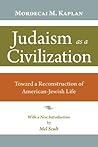
 Judaism as a Civilization: Toward a Reconstruction of American Jewish Life by Rabbi Mordecai M. Kaplan
My rating: 5 of 5 stars
Mordecai Kaplan was incredibly prolific over his long life but is likely best known for his tome: Judaism as a Civilization: Toward a Reconstruction of American-Jewish Life. And rightly so. This is a transformative work that was incredibly influential. While Reconstructionist Judaism as a Jewish denomination didn’t catch on in large numbers, so much of what Kaplan argues for here gets adopted or absorbed, to some degree or another, by other denominations, but in particularly Reform, that Kaplan’s vision might be even more successful than what we might think if we just count organized congregations.
The book was first published in 1934, with several reprintings. One of the striking things about the book is that it doesn’t usually feel that dated or that old. In the first part of the book, Kaplan examines and diagnoses many problems within the Jewish world. So much of this could have been about problems we still face today (problems arising from intermarriage, Jews feeling disengaged by the Jewish establishment, feeling torn between the needs of a modern world and the pull of one’s Jewish heritage). And so many of Kaplan’s answers are still relevant.
There is so much that Kaplan covers in this 500+ work, so I want to focus on some of the core themes.
The core theme is Judaism in the modern world: how can being Jewish be meaningful in the modern world where many of the traditional explanations, justifications, and approaches to Jewish practice and thought ring hollow. Kaplan sees two main organized responses: what he calls neo-Orthodoxy and Reform.
Neo-Orthodoxy retreats to, or more charitably, continues to find the traditional justifications normative. Kaplan regards this as untenable post-enlightenment. Kaplan’s view of God and theology is, or has been called, a kind of religious naturalism. He is not atheistic in the way that a Sam Harris or Rabbi Sherwin Wine (the founder of Humanistic Judaism) would be described. His view is more Spinoza-like: God is the way we understand the full-total of the powers and forces of the universe: “God is the life of the universe, immanent insofar as each part acts upon every other, and transcendent insofar as the whole acts upon each part” (316). Holiness, sacredness are the ways we experience the worthiness of life, the significance of the world.
But he has far more scathing things to say about the Reform movement (at least the Reform movement in the early part of the 20th century). The Reform movement is also an attempt to deal with Judaism in the modern world. But Kaplan sees this movement as based on fatal mistaken premise: Judaism is just a religion. It is merely another confessional, monotheistic faith. In the most radical forms: Judaism comes to be, in my words, just a really weird form of Protestantism. Kaplan sees this premise as leading to (at his time) the Reform movement’s rejection of the important role of Jewish law, history, Talmudic study, connection to Israel as the ancestral Jewish homeland, etc. All that is left is some vague notion of monotheism and tikkun olam (social justice), none of it particularly rooted. (The contemporary Reform movement seems to have moved away from these rejections – I think in large part to Kaplan’s (and those influenced by him) criticisms.)
Instead, Kaplan proposes a different path. We need to reinterpret, reconstruct, Judaism and Jewish life by understanding the spiritual and real-world needs that the earlier forms of Judaism (Temple period, exile period, Rabbinical periods) were meant to meet; and reconstructing modern forms of Judaism to meet these needs. Kaplan sees human nature, and our needs as humans, as relatively stable: we share the same spiritual needs as our forebears. But our world, our environment is different and so the ways to meet and satisfy these needs has to be different. Kaplan argues that by doing this, we maintain continuity with our past and our traditions but are able to live vital, flourishing modern Jewish lives.
Another core idea in Kaplan is the idea of Judaism as a Civilization. Here Kaplan is grappling with one of the thorniest issues in understanding Judaism. It can’t just be a revealed religion or just a form of ethical monotheism. This strips Judaism of its uniqueness; its history, its language, literature, its folkways, etc. It fails to explain the connection Jews feel for each other and their historic connection to Eretz Israel. Nor it is an ethnicity or ‘race’: this fails to account for the vast diversity of Jews or the reality of conversion. Kaplan’s answer is to understand it as a civilization: a way of life for a connected people: “the social framework of national unity centering in a particular land, a continuing history, a living language and literature, religious folkways, mores, laws and art” (513). It’s more common in contemporary parlance to talk about this as ‘peoplehood.’ Jews are, as Dara Horn puts, “a joinable tribal group with a shared history, homeland, and culture.”
Much of the book is fleshing out these ideas. The first part diagnoses the problems facing the American Jewish world in the early 20th century and the various ways contemporaneous Jewish movements addressed these (or in Kaplan’s view fail to address these). The second half of the book is Kaplan’s articulation of how a reconstructed Judaism could work: how it would deal with the problems raised by modernity, but remain rooted in Israel, God, and Torah.
I found the book endless thought-provoking and intriguing. I certainly don’t agree with all of it; but there is a lot I do agree with: I can't accept orthodoxy or the traditional justifications, but I find Reform empty and bland. I wish more of his advice had been taken in a more widespread way by the American Jewish community: I think it would be more vital, more engaged, and more Jewish. I even looked up to see if there was Reconstructionist synagogue near me (there isn’t). (though I am not sure how much the contemporary movement is still aligned with Kaplan’s ideas in this book – some of what I’ve read about it makes me quite skeptical.)
Obviously, this is not a book for everyone; no casual read is this. It’s long, though not difficult. It gets into the weeds of things, some of which is no longer relevant. While there are some dated ideas and language, it doesn’t feel overall dated. The most dated elements are probably some of the more sociological frameworks that Kaplan relies on. But if you are keenly interested in the history of American Judaism and how one might understand Judaism in the modern world, I’d recommend diving into this.
View all my reviews