April's column for Or Adam:
Continuing our tour of early Jewish philosophers, this month we will look at Levi ben Gerson (also known as Ralbag or Gersonides). Born in 1288 in Provence, Gersonides was an important and influential figure in medieval Jewish philosophy. He died in 1344.
Like Philo and Maimonides before him, Gersonides attempts to reconcile Greek philosophy with Jewish theology. Unlike the earlier thinkers, however, Gersonides had robust knowledge of mathematics and astronomy. Norbert Samuelson says of Gersonides: “he could arguably be considered the most important astronomer in Christian Europe before Galileo” (228). He brought this knowledge to bear on his philosophical thinking, giving it an empirical and scientific basis lacking in the earlier synthetic adventures. He criticizes Maimonides for trying to stay neutral on cosmological questions and he argues that astronomy and reason can provide definitive answers.
Heavily influenced by Maimonides and Aristotle, Gersonides sees reason as the ultimate arbiter of truth. He believed that the Torah and reason could not conflict; but where they apparently did, one needed, according to Gersonides, to interpret the Torah in a way compatible with reason. Humans, using their faculty of reason, can gain knowledge and understanding of the universe and there is nothing, according to Gersonides, that is in principle out of reason’s reach.
Like Philo and Maimonides, Gersonides believes in God and the Torah. But their attempts at synthesis are what make these thinkers important for secular humanism. The continual and ruthless injection of reason into attempts at understanding the world paves the way for secular humanism. Gersonides, with his consistent and rigorous rationalism, expands the scope of reason and science in grasping the truths of existence and thus, quite unintentionally, limits the scope of faith and the supernatural.
Sources: The Stanford Encyclopedia of Philosophy and Jewish Philosophy: An Historical Introduction by Norbert Samuelson.
Saturday, March 31, 2007


Tuesday, March 27, 2007
The New Kiekekaard

Cow and Boy is a relatively new strip and has quickly risen to one my favorites. It's got a Calvin & Hobbes feel, but instead of a stuffed tiger, it's a talking cow.
Saturday, March 24, 2007
SUPHI: Discussion Question: Origins
Over at Suphi, I posted the following discussion question:
My response was:
I am often amazed at the different ways that individuals have come to philosophy. Some from a novel or movie, others through religion, many through a philosophy course, and even a few from coming across and reading actual contemporary philosophy on their own.
So I am curious: What inspired your desire to learn more about and study philosophy? Was it a book(s)? What book(s) and why? Did you arrive here from some other path?
My response was:
I was a voracious reader from a young age and novels where my entrance point to philosophy. Some of the earliest novels I read that got me thinking, with hindsight, more philosophically were: Atlas Shrugged by Ayn Rand, The Catcher in the Rye by J.D. Salinger, and Brave New World by Aldous Huxley. I read these first (I’ve read each of these at least three times) between 11-14 years-old. The first reads were, for the most part, over my head. Nonetheless, they started me thinking about the way the world was: the nature of good and evil, the influence and danger of authority and power, and how individuals relate (or fail to) to each other. These are themes I still think about and struggle with to this day.
My freshman year at Tufts, I took an introduction to philosophy class where we read Plato, Descartes, and Quine. (Yes "two dogmas" during my first semester of college!) I hated my teacher, so I got somewhat turned off to academic philosophy and ended up an English major. By my junior year, I had reread all three of the above novels again and my interest in philosophy re-emerged. I took several more philosophy courses and the rest, as they say, is history.
Friday, March 23, 2007
ASU Philosophy Graduate Students
Along with several of my fellow graduate students, I have started up a group blog: ASU Philosophy Graduate Students. It's already got a few interesting posts. I plan on cross-posting to Philosophy Blog my posts. I might repost comments here as well as I see fit.
Monday, March 05, 2007
Scholarly Notes: Milton Friedman
March column for Or Adam:
For this month's column, we move to the present day to look at one of the most influential secular Jewish intellectuals of the 20th century. Milton Friedman was born on July 31, 1912 in Brooklyn, NY to an Orthodox Jewish family. As Friedman recalls, he was fanatic in his preteen years about observing the Jewish laws. He began, however, to question the rational basis for these laws and finding none, rejected religion.
Friedman won the Noble Prize in Economics in 1976. He was also awarded the National Medal of Science and the Presidential Medal of Freedom in 1988. His major achievements were in economic theory, but not just in academia. Friedman worked for several federal administrations starting with President Franklin Roosevelt. While working at the Department of Treasury during World War II, Friedman helped to invent the payroll withholding tax system that most of us are all too familiar with and that Friedman would later regret. He was an adviser for several U.S. presidents, including Presidents Nixon and Reagan, as well as British Prime Minister Margret Thatcher. Serving on the Gates Commission--President Nixon's Advisory Commission on an All-Volunteer Force--Friedman was a vigorous and ultimately victorious voice against the military draft. Friedman also was the intellectual force behind school choice, proposing in 1955 a system of school vouchers to introduce competition and choice into education.
Friedman communicated his economic and political ideas to the general public as well. He made a popular series with PBS in 1980 called "Free to Choose" which was later made into a bestselling book by the same name. It was updated in 1990 and is now available for free on the web: http://www.ideachannel.tv/ He wrote a regular column for Newsweek from 1966 until 1983 and gave lectures around the world.
The focus of most of his work was on economics and politics with the goal of creating and spreading more autonomy and freedom throughout the world. Friedman did not speak about god or religion often. From what he does say, it is clear that Friedman viewed the question of god as unanswerable, unverifiable, and ultimately irrelevant. What was important was that individuals had the freedom to choose and live their lives. Milton Friedman died at the age of 94 on November 16, 2006.
Sources: Wikipedia; interview, Academy of Achievement; biography, Cato Institute.
For this month's column, we move to the present day to look at one of the most influential secular Jewish intellectuals of the 20th century. Milton Friedman was born on July 31, 1912 in Brooklyn, NY to an Orthodox Jewish family. As Friedman recalls, he was fanatic in his preteen years about observing the Jewish laws. He began, however, to question the rational basis for these laws and finding none, rejected religion.
Friedman won the Noble Prize in Economics in 1976. He was also awarded the National Medal of Science and the Presidential Medal of Freedom in 1988. His major achievements were in economic theory, but not just in academia. Friedman worked for several federal administrations starting with President Franklin Roosevelt. While working at the Department of Treasury during World War II, Friedman helped to invent the payroll withholding tax system that most of us are all too familiar with and that Friedman would later regret. He was an adviser for several U.S. presidents, including Presidents Nixon and Reagan, as well as British Prime Minister Margret Thatcher. Serving on the Gates Commission--President Nixon's Advisory Commission on an All-Volunteer Force--Friedman was a vigorous and ultimately victorious voice against the military draft. Friedman also was the intellectual force behind school choice, proposing in 1955 a system of school vouchers to introduce competition and choice into education.
Friedman communicated his economic and political ideas to the general public as well. He made a popular series with PBS in 1980 called "Free to Choose" which was later made into a bestselling book by the same name. It was updated in 1990 and is now available for free on the web: http://www.ideachannel.tv/ He wrote a regular column for Newsweek from 1966 until 1983 and gave lectures around the world.
The focus of most of his work was on economics and politics with the goal of creating and spreading more autonomy and freedom throughout the world. Friedman did not speak about god or religion often. From what he does say, it is clear that Friedman viewed the question of god as unanswerable, unverifiable, and ultimately irrelevant. What was important was that individuals had the freedom to choose and live their lives. Milton Friedman died at the age of 94 on November 16, 2006.
Sources: Wikipedia; interview, Academy of Achievement; biography, Cato Institute.
Saturday, February 10, 2007
Philo of Alexandria
My second column for the Or Adam newsletter focused on Philo of Alexandria:
Philo Judaeus, better known as Philo of Alexandria, lived from around 20 B.C.E to 50 C.E. in Alexandria, Egypt and is often identified as the first Jewish philosopher. Like Maimonides, who comes a millennium after him, Philo was interested in reconciling Jewish and Greek thought. Unlike Maimonides, Philo is more heavily influenced by Plato and the Stoics rather than Aristotle. Many of Philo's writings on the existence and nature of God, the creation of the world, and the virtues are similar to the doctrines of Platonic and Stoic thought.
Philo's importance to Jewish philosophy is relatively minor. He is not the touchstone or innovator of Jewish thought that Maimonides is. Philo's philosophical view of Judaism was not widely accepted in his lifetime or later. He did, however, have an important, though sometimes disputed, influence on the development of Christianity. There is, according to some scholars, reason to think that he influenced Paul and some other writers of the Gospels.
So in what sense is he a Jewish philosopher? First, the focus of much of his attention is on the biblical ideas; and in particular, on Moses and the foundations of the Law. Second, Philo sought to show that Greek philosophy provided the best means by which to understand Torah and its law.
Philo's importance to secular Judaism is, like many of the Jewish philosophers this column will look at, indirect. Philo had no intention, and would likely be appalled at, rejecting or sidelining God. He is, nonetheless, interesting from a secular humanistic perspective because he was one of the first Jewish thinkers to explicitly use reason and philosophy to grapple with the sacred Jewish texts. By placing reason at the center of his methodology for understanding the world, Philo helps to make possible secular humanism.
Sources: Jewish Philosophy by Norbert Samuelson; A History of Philosophy, Vol 1 by Frederick Copleston; Wikipedia, JewishEncyclopedia.com and The Internet Encyclopedia of Philosophy.
Philo Judaeus, better known as Philo of Alexandria, lived from around 20 B.C.E to 50 C.E. in Alexandria, Egypt and is often identified as the first Jewish philosopher. Like Maimonides, who comes a millennium after him, Philo was interested in reconciling Jewish and Greek thought. Unlike Maimonides, Philo is more heavily influenced by Plato and the Stoics rather than Aristotle. Many of Philo's writings on the existence and nature of God, the creation of the world, and the virtues are similar to the doctrines of Platonic and Stoic thought.
Philo's importance to Jewish philosophy is relatively minor. He is not the touchstone or innovator of Jewish thought that Maimonides is. Philo's philosophical view of Judaism was not widely accepted in his lifetime or later. He did, however, have an important, though sometimes disputed, influence on the development of Christianity. There is, according to some scholars, reason to think that he influenced Paul and some other writers of the Gospels.
So in what sense is he a Jewish philosopher? First, the focus of much of his attention is on the biblical ideas; and in particular, on Moses and the foundations of the Law. Second, Philo sought to show that Greek philosophy provided the best means by which to understand Torah and its law.
Philo's importance to secular Judaism is, like many of the Jewish philosophers this column will look at, indirect. Philo had no intention, and would likely be appalled at, rejecting or sidelining God. He is, nonetheless, interesting from a secular humanistic perspective because he was one of the first Jewish thinkers to explicitly use reason and philosophy to grapple with the sacred Jewish texts. By placing reason at the center of his methodology for understanding the world, Philo helps to make possible secular humanism.
Sources: Jewish Philosophy by Norbert Samuelson; A History of Philosophy, Vol 1 by Frederick Copleston; Wikipedia, JewishEncyclopedia.com and The Internet Encyclopedia of Philosophy.
Friday, February 02, 2007
Save the 911 Memorial
I am not usually one to sign or pass on online petitions. This one, however, seemed worthy of an exception.
Apparently, the latest plan for the World Trade Center Memorial is to list the names randomly, with no discernible order or grouping, and no information about the individuals (such as age). The petition is to change this so that the names are listed so that "the arrangement of names at the WTC Memorial must answer the following questions: What was the victim’s name? How old was he/she? Where did he/she work? Where was he/she on 9/11?"
I don't like the random listing of names, in part because I can see no meaningful purpose in doing so. It serves to dehumanize the individuals murdered that day; as well as making it quite difficult to find a name. There should be some rational ordering of the names that provides context to the individual victims and allows mourners and visitors to easily find the names.
That's why I signed this petition, and why I am passing on to you.
http://www.savethe911memorial.com/petition.html
Apparently, the latest plan for the World Trade Center Memorial is to list the names randomly, with no discernible order or grouping, and no information about the individuals (such as age). The petition is to change this so that the names are listed so that "the arrangement of names at the WTC Memorial must answer the following questions: What was the victim’s name? How old was he/she? Where did he/she work? Where was he/she on 9/11?"
I don't like the random listing of names, in part because I can see no meaningful purpose in doing so. It serves to dehumanize the individuals murdered that day; as well as making it quite difficult to find a name. There should be some rational ordering of the names that provides context to the individual victims and allows mourners and visitors to easily find the names.
That's why I signed this petition, and why I am passing on to you.
http://www.savethe911memorial.com/petition.html
Monday, January 29, 2007
The Life and Ideas of Milton Friedman
Worth Watching:
Power of Choice: The Life and Ideas of Milton Friedman
Monday, January 29, 2007, 10pm (AZ time) on PBS, Channel 8.
"A documentary on the life and ideas of Nobel-winning economist Milton Friedman (1912-2006), with comments from former Federal Reserve chairman Alan Greenspan; economists Gary Becker and Paul Samuelson, and former Estonian prime minister Mart Laar."
Power of Choice: The Life and Ideas of Milton Friedman
Monday, January 29, 2007, 10pm (AZ time) on PBS, Channel 8.
"A documentary on the life and ideas of Nobel-winning economist Milton Friedman (1912-2006), with comments from former Federal Reserve chairman Alan Greenspan; economists Gary Becker and Paul Samuelson, and former Estonian prime minister Mart Laar."
Sad News
Some sad news to report. I heard today that Professor Fitch, of the ASU Philosophy Department, passed away this weekend. He had been on leave this semester and last to battle the illness he had, but succumbed on Saturday morning. I never took a course with Prof. Fitch and didn't know him well, but he was very popular among the students (undergrad and grad alike) and was deeply respected by the faculty.
Sunday, January 28, 2007
Proper Grad Student Etiquette
For all those who ask this of me regularly:
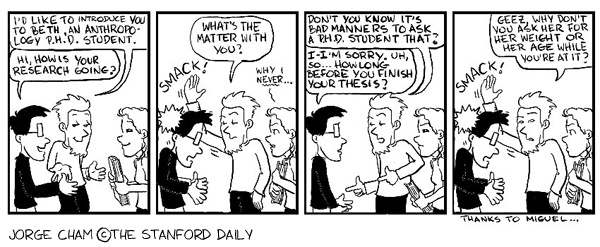
From PHD Comics. (click on image to see it in full resolution)
From PHD Comics. (click on image to see it in full resolution)
Maimonides
I've begun writing a short monthly column for the Or Adam newsletter. Each month, I'll briefly discuss an important thinker in Jewish history or in secular humanist thought. The following was the first "Scholarly Notes" with a focus on Maimonides.
One of the greatest scholars of medieval Jewish history, and arguably of any period, was the Spanish born Moses ben Maimon, better known by his Greek name: Maimonides. Born in Córdoba in 1135, Maimonides eventually settles in Cairo after moving around to escape Muslim persecution and forced conversions of Jews. In Cairo, he rises to prominence as an influential physician and philosopher. He was an expert in Greek philosophy and wrote many secular medical treatises, but his two most famous works are religious in focus: the Mishneh Torah and The Guide to Perplexed. The Mishneh Torah was the Jewish world's first comprehensive law code, integrating laws and rulings from the Tanakh, the Talmuds, Midrashic literature, contemporary rabbinic writings, and even non-Jewish sources like Aristotle. The Guide to the Perplexed seeks to put Jewish law and beliefs on a solid rational basis; that is, he argues that the beliefs were not just the dictates of the Torah or rabbis, but were deduced and proven by reason. In doing so, Maimonides attempts a synthesis of Jewish thinking and Aristotelian philosophy. Although Maimonides' rationalism met much opposition in the Jewish world, many of his views are today taken, at least by the Orthodox, to be defining elements of Judaism. Maimonides also had a profound influence the non-Jewish world. He set the ground for much of later Christian Medieval philosophy: including Thomas Aquinas who attempts, similar to Maimonides' synthesis of Judaism and Aristotelianism, a synthesis of Christianity and Aristotelianism. With Maimonides' attempt to put Jewish thought and beliefs on a rational basis, we should also see him, though quite unintentionally, as setting the stage for later secular Jewish thinking.
Sources: The Teaching Company's Introduction to Judaism by Shai Cherry; A History of the Jews by Paul Johnson; and Wikipedia.
One of the greatest scholars of medieval Jewish history, and arguably of any period, was the Spanish born Moses ben Maimon, better known by his Greek name: Maimonides. Born in Córdoba in 1135, Maimonides eventually settles in Cairo after moving around to escape Muslim persecution and forced conversions of Jews. In Cairo, he rises to prominence as an influential physician and philosopher. He was an expert in Greek philosophy and wrote many secular medical treatises, but his two most famous works are religious in focus: the Mishneh Torah and The Guide to Perplexed. The Mishneh Torah was the Jewish world's first comprehensive law code, integrating laws and rulings from the Tanakh, the Talmuds, Midrashic literature, contemporary rabbinic writings, and even non-Jewish sources like Aristotle. The Guide to the Perplexed seeks to put Jewish law and beliefs on a solid rational basis; that is, he argues that the beliefs were not just the dictates of the Torah or rabbis, but were deduced and proven by reason. In doing so, Maimonides attempts a synthesis of Jewish thinking and Aristotelian philosophy. Although Maimonides' rationalism met much opposition in the Jewish world, many of his views are today taken, at least by the Orthodox, to be defining elements of Judaism. Maimonides also had a profound influence the non-Jewish world. He set the ground for much of later Christian Medieval philosophy: including Thomas Aquinas who attempts, similar to Maimonides' synthesis of Judaism and Aristotelianism, a synthesis of Christianity and Aristotelianism. With Maimonides' attempt to put Jewish thought and beliefs on a rational basis, we should also see him, though quite unintentionally, as setting the stage for later secular Jewish thinking.
Sources: The Teaching Company's Introduction to Judaism by Shai Cherry; A History of the Jews by Paul Johnson; and Wikipedia.
Some changes
In the last month or so, I've started blogging regularly (and simultaneously with Philosophy Blog) at my myspace blog. I've decided that instead of posting the same things on each blog, I want to differentiate the purpose of each. Philosophy Blog will return to its initial purpose: a place for me to blog about philosophically related topics, issues, and questions. All the personal, quirky, silly blogging will go on Myspace Blog, which will also automatically feed into my Facebook profile. There will be occasional crossover blogs, but I will try to keep to this division.
I haven't decided yet if I am going to clean out the non-philosophy related blogs at Philosophy Blog or not. I most likely will keep the older, pre-myspace blogs, but will delete the posts that are duplicated at myspace.
I haven't decided yet if I am going to clean out the non-philosophy related blogs at Philosophy Blog or not. I most likely will keep the older, pre-myspace blogs, but will delete the posts that are duplicated at myspace.
Friday, January 26, 2007
Comic Censorship
My loyal and valued readers will have noticed that I posted a Get Fuzzy comic strip earlier in the week. This strip started a story line of Bucky running for president and sharing his campaign signs with Rob (aka Pinkie) and Satchel. The gag was that Bucky was inadvertently referencing marijuana in his ads. Today's comic, for instance, shows Bucky trying to get the Christian vote with a biblical reference: "Bucky Katt: More Fun than Being Stoned".

I bring this up again because I noticed that the Arizona Republic was running a different set of Get Fuzzy strips. I also spoke to my mother in Boston and the Boston Globe is also not running the Bucky For President story line.
I am outraged at this ridiculous censorship. There is no notice that this strip is different. What else is being censored in the paper without our knowledge? I am going to write the AZ Republic and may even cancel my subscription.

I bring this up again because I noticed that the Arizona Republic was running a different set of Get Fuzzy strips. I also spoke to my mother in Boston and the Boston Globe is also not running the Bucky For President story line.
I am outraged at this ridiculous censorship. There is no notice that this strip is different. What else is being censored in the paper without our knowledge? I am going to write the AZ Republic and may even cancel my subscription.
Thursday, January 25, 2007
For my fellow Sports Guy fans
From The Onion:
Confused Bill Simmons Picks The Departed To Win Super Bowl
LOS ANGELES—Pop-culture enthusiast and sportswriter Bill Simmons, a regular columnist for ESPN's Page 2, was evidently suffering from genre confusion earlier this week when he picked Martin Scorsese's The Departed to win Super Bowl XLI.
Read the rest...
Read Bill Simmons "The Sports Guy".
Confused Bill Simmons Picks The Departed To Win Super Bowl
LOS ANGELES—Pop-culture enthusiast and sportswriter Bill Simmons, a regular columnist for ESPN's Page 2, was evidently suffering from genre confusion earlier this week when he picked Martin Scorsese's The Departed to win Super Bowl XLI.
Read the rest...
Read Bill Simmons "The Sports Guy".
Wednesday, January 24, 2007
More good news on coffee
Study: Coffee May Slow Balding
Just 60 cups a day...
Object lesson: Dose makes the poison (or in this case the cure)
Just 60 cups a day...
Object lesson: Dose makes the poison (or in this case the cure)
Tuesday, January 23, 2007

Sunday, January 21, 2007
Monday, January 15, 2007
Review is published!
My review, referred to in several earlier posts, of Norms of Liberty: A Perfectionist Basis for Non-perfectionist Politics by Douglas Rasmussen and Douglas Den Uyl has been published in the The Independent Review. I've been a fan of 'the Dougs' work for a long time and so it was a great honor and privilege to review their latest work. And Norms of Liberty is a very good and worthwhile book. So, as I do in the review, I recommend it here as well.
Read the review...
Read the review...
Patriots to the AFC Championship Game
I must admit that I think that being a Patriots and Red Sox fan has easily taken 5 years off my life. The level of stress in watching playoff games can't be healthy. But with the Pats returning to the AFC Championship game, it's worth it.
The Pats beat the Chargers yesterday in a hard fought, down in the trenches kind of game. Neither team seemed to be able to get a sustained rhythm going. The Chargers got something going in the first half and got two touchdowns; but the Patriots scored right before the half to keep the game with in 4 and then in the second half the Patriots just seemed to be building while the Chargers seemed to fade: they started to make more mistakes and panic a little. I was surprised to see them move away from the run as much as they did. LT wasn't breaking too many big runs, but he was doing a good job of wearing things down. The Patriots, supremely confident in their ability to win, just kept coming and eventually evened the score and then went ahead on the young rookie kicker's leg.
This game was one of the most stressful games I've ever watched. I swear it was more gut-wrenching than the Super Bowls--but that's probably just because of proximity.
So on to Indy. This will be another battle. The Colts have been, surprisingly, winning with their D the last few games. But this game will be a real test for the Colts. The Ravens had little offensive power and the Chiefs, backing into the playoffs because of Denver's lost, were just not a very good football team this year. They were basically one-dimensionally on offense and so a team like that is going to be stopped in the playoffs. The Patriots are not one dimensional. They can score on the ground or in the air. (Dillion and Maroney combined for 23 yards and the Pats put up 24 points). Manning is always a powerful offensive weapon -- even when he's not playing well. It'll be an exciting, heart-pounding, hair-pulling out game; but I like the Pats chances for a fourth Super Bowl appearance in the Double-O Decade.
I'm also going to go with Saints in the NFC Championship game. I continue to be under-impressed by the Bears; though kudos to Grossman for playing well yesterday.
The Pats beat the Chargers yesterday in a hard fought, down in the trenches kind of game. Neither team seemed to be able to get a sustained rhythm going. The Chargers got something going in the first half and got two touchdowns; but the Patriots scored right before the half to keep the game with in 4 and then in the second half the Patriots just seemed to be building while the Chargers seemed to fade: they started to make more mistakes and panic a little. I was surprised to see them move away from the run as much as they did. LT wasn't breaking too many big runs, but he was doing a good job of wearing things down. The Patriots, supremely confident in their ability to win, just kept coming and eventually evened the score and then went ahead on the young rookie kicker's leg.
This game was one of the most stressful games I've ever watched. I swear it was more gut-wrenching than the Super Bowls--but that's probably just because of proximity.
So on to Indy. This will be another battle. The Colts have been, surprisingly, winning with their D the last few games. But this game will be a real test for the Colts. The Ravens had little offensive power and the Chiefs, backing into the playoffs because of Denver's lost, were just not a very good football team this year. They were basically one-dimensionally on offense and so a team like that is going to be stopped in the playoffs. The Patriots are not one dimensional. They can score on the ground or in the air. (Dillion and Maroney combined for 23 yards and the Pats put up 24 points). Manning is always a powerful offensive weapon -- even when he's not playing well. It'll be an exciting, heart-pounding, hair-pulling out game; but I like the Pats chances for a fourth Super Bowl appearance in the Double-O Decade.
I'm also going to go with Saints in the NFC Championship game. I continue to be under-impressed by the Bears; though kudos to Grossman for playing well yesterday.
Monday, January 08, 2007
Patriots Advance
My New England Patriots beat the Jets on Sunday 37-16 to advance to the next round of the AFC playoffs. They'll face the San Diego Chargers on Sunday afternoon.
The Jets presented a tough challenge for the Pats--the score belies a contested game until the fourth quarter. The Jets have a lot of talent and, now, with Mangini (a former Patriots assistant coach) they are very well coached.
San Diego presents an entirely different challenge. They are so talented on both sides of the ball, they will be tough to stop. Belichick is a master of game planning to stop one player; so I'll imagine they'll scheme to make Rivers beat them rather than their MVP, offensive player of the year running back. Of course, even if they beat the Chargers, the Pats would then have to play either the Ravens or the Colts: neither one a picnic in the park.
On Saturday, I watched the last quarter of the Dallas-Seattle match-up. Dallas had a chance to win but their young quarterback miffed the hold for a field goal and then failed to make the first down or a TD after recovering the ball. A very tough and heart-wrenching way to lose. I had no dog in this race, but I'd hate to be a Dallas fan: my Cowboy fan friend Joe Duarte's response to the game. I do give Romo some credit for immediately picking up the ball on running for the end zone, that was quick thinking and a few inches more and he might have made it. That's what is so great about football: a few inches either way and you can be a hero or a goat.
Divisional Playoffs:
Eagles @ Saints. I'll go with the Saints in this game. They are at home, and the Eagles just barely escaped from the Giants.
Colts @ Ravens. This is tough; a lot of drama to this game. Colts return to Baltimore. Manning against the Ravens D. I'll go with the home team again.
Seattle @ da Bears. Kind of depends on the weather. If it's a typical January in Chicago, no way Seattle wins. Otherwise it could be close, especially if Rex Grossman doesn't control himself. I'll have to go with the home team again.
Pats @ Chargers. I can't be objective here. It'll be tough, but Pats will pull it out in a classic Pats fashion.
The Jets presented a tough challenge for the Pats--the score belies a contested game until the fourth quarter. The Jets have a lot of talent and, now, with Mangini (a former Patriots assistant coach) they are very well coached.
San Diego presents an entirely different challenge. They are so talented on both sides of the ball, they will be tough to stop. Belichick is a master of game planning to stop one player; so I'll imagine they'll scheme to make Rivers beat them rather than their MVP, offensive player of the year running back. Of course, even if they beat the Chargers, the Pats would then have to play either the Ravens or the Colts: neither one a picnic in the park.
On Saturday, I watched the last quarter of the Dallas-Seattle match-up. Dallas had a chance to win but their young quarterback miffed the hold for a field goal and then failed to make the first down or a TD after recovering the ball. A very tough and heart-wrenching way to lose. I had no dog in this race, but I'd hate to be a Dallas fan: my Cowboy fan friend Joe Duarte's response to the game. I do give Romo some credit for immediately picking up the ball on running for the end zone, that was quick thinking and a few inches more and he might have made it. That's what is so great about football: a few inches either way and you can be a hero or a goat.
Divisional Playoffs:
Eagles @ Saints. I'll go with the Saints in this game. They are at home, and the Eagles just barely escaped from the Giants.
Colts @ Ravens. This is tough; a lot of drama to this game. Colts return to Baltimore. Manning against the Ravens D. I'll go with the home team again.
Seattle @ da Bears. Kind of depends on the weather. If it's a typical January in Chicago, no way Seattle wins. Otherwise it could be close, especially if Rex Grossman doesn't control himself. I'll have to go with the home team again.
Pats @ Chargers. I can't be objective here. It'll be tough, but Pats will pull it out in a classic Pats fashion.
Subscribe to:
Posts (Atom)