The Israeli journal, Azure, has an interesting review of two books on Iranian youth culture: Lipstick Jihad: A Memoir of Growing Up Iranian in America and American in Iran by Azadeh Moaveni and Warring Souls: Youth, Media, and Martyrdom in Post-Revolution Iran by Roxanne Varzi. Each of these books, according to the review, provide insight into the complexity and paradoxes of the Iranian youths. Iran, ruled by a click of dictatorial theocrats, is largely inhabited by disaffected and alienated young men and women who want nothing more than to drink alcohol, have sex, and listen to rock music.
The hopeful elements presented in these books are that the youth appear to want liberty and to dislike the authoritarian regime. This holds the promise of new Iranian revolution that could oust the current repressive and dangerous regime. Whether this can happen before Iran must be bombed to prevent it from going nuclear is an important question.
A most disheartening element,however, appears in the review. According to one of the authors reviewed, Varzi, there is a deeply ingrained reliance on authority and little individualism. She describes how even in simple social activities like a ski trip or party, there was "nothing that was done spontaneously or from individual initiative. The group was always consulted; everyone participated once the activity was decided on, and there was always somehow a de facto leader (chosen usually for age and experience) whom everyone deferred to." This is hardly promising. Even if a revolution could occur, it could very well usher in just a different authoritarianism. Nonetheless a more secular authoritarianism might be preferable to the maniacal, death-obsessed Islamic authoritarianism already in power.
The review has piqued my interest enough to add these to my amazon wish list.
Saturday, June 02, 2007


Friday, May 25, 2007
Who Needs Philosophy?
As I will soon be losing my web site at MCC, it was time to start up a new website for my classes. To that end, I've started www.whoneedsphilosophy.com. This site is for my students to find out more information about their classes, their instructor, and philosophy in general. Others are welcome to peruse the site as well.
Thursday, May 24, 2007
The Evil Competition: Nazis and Communists
Stephen Browne has an interesting post , distributed as a column by The Atlasphere, that wonders why Nazis are the epitome of evil while the Soviets and Communist Chinese have body counts that are orders of magnitude larger. Hitler is the ultimate way to call some one evil, but Stalin, Lenin, or Mao are not. This is something that I have wondered myself. I am disgusted by the college students I see wearing t-shirts with Che, Mao, or Lenin on them. Are they just stupid and ignorant or something much worse?
I posted a comment to Stephen Browne's blog along the following lines (I forgot to copy and paste it and the comment is awaiting approval, so I am rewriting from memory).
I wonder if part of the reason that the Nazis are seen as worse, as more evil, than the Soviets, etc., is the systematic, methodical plan to kill entire races of people. The communists had their camps and mass executions, but they generally only murdered their perceived enemies and those that were deemed beyond 'rehabilitation' or 'reeducation'. They didn't target, to my knowledge, people solely because they were Jewish, gay, gypsie, etc.
Another aspect of this is that the Nazis had no qualms about murdering children. They actively targeted and killed children of all ages. (1.5 million Jewish children were murdered by the Nazi's during the Shoah). To my knowledge, the communists usually didn't target children for execution. (not to imply that children weren't murdered by the Soviets/Chinese/etc.)
I think for many people in comparing the Nazis with the Soviets/Chinese/etc. considerations of intentions and goals are trumping the body counts.
Ultimately, both the Nazis and Communists were and are evil. There is a certain point where trying to make distinctions like "more evil" no longer makes sense.
I posted a comment to Stephen Browne's blog along the following lines (I forgot to copy and paste it and the comment is awaiting approval, so I am rewriting from memory).
I wonder if part of the reason that the Nazis are seen as worse, as more evil, than the Soviets, etc., is the systematic, methodical plan to kill entire races of people. The communists had their camps and mass executions, but they generally only murdered their perceived enemies and those that were deemed beyond 'rehabilitation' or 'reeducation'. They didn't target, to my knowledge, people solely because they were Jewish, gay, gypsie, etc.
Another aspect of this is that the Nazis had no qualms about murdering children. They actively targeted and killed children of all ages. (1.5 million Jewish children were murdered by the Nazi's during the Shoah). To my knowledge, the communists usually didn't target children for execution. (not to imply that children weren't murdered by the Soviets/Chinese/etc.)
I think for many people in comparing the Nazis with the Soviets/Chinese/etc. considerations of intentions and goals are trumping the body counts.
Ultimately, both the Nazis and Communists were and are evil. There is a certain point where trying to make distinctions like "more evil" no longer makes sense.
Wednesday, May 02, 2007
Rockford Bound
I am very pleased to announce that I have been offered and have accepted the job at Rockford College. Rockford is a small, private liberal arts college in Rockford, Illinois. It's about 90 miles NNW of Chicago.
I'll be teaching a 4-4 load from a mix of different classes. The fall slate is Intro to Philosophy and upper-division sections of Ethical Theory and Business Ethics.
[update 5/2/07 4.19pm] Rockford has produced this flyer announcing my hire!
I'll be teaching a 4-4 load from a mix of different classes. The fall slate is Intro to Philosophy and upper-division sections of Ethical Theory and Business Ethics.
[update 5/2/07 4.19pm] Rockford has produced this flyer announcing my hire!
Thursday, April 12, 2007
What's Wrong with Contemporary Philosophy?
[cross-listed at SUPHI]
Here's an interesting article that attempts a diagnosis of contemporary philosophy and why it seems not to progress or hold much external sway.
http://ontology.buffalo.edu/smith/articles/What'sWrong.pdf (Hat tip Stephen Hicks)
I am sympathetic to the points made in the article, in particular regarding analytic philosophy. Analytic philosophy has, in its current academic form, largely become irrelevant, esoteric, and insular. What used to be -- and still is billed as such -- the quest for asking and answering "The Big Questions" has become overly concerned with technical terminology and peculiar puzzles.
Can you really imagine Aristotle at the Lyceum worrying about whether it is a logical possibility for a cat to give birth to an elephant? I recall several times thinking in a seminar: "if we resolved this _fill in the blank_ puzzle, definitely and once for all, what difference does it make?"
Here's an interesting article that attempts a diagnosis of contemporary philosophy and why it seems not to progress or hold much external sway.
http://ontology.buffalo.edu/smith/articles/What'sWrong.pdf (Hat tip Stephen Hicks)
I am sympathetic to the points made in the article, in particular regarding analytic philosophy. Analytic philosophy has, in its current academic form, largely become irrelevant, esoteric, and insular. What used to be -- and still is billed as such -- the quest for asking and answering "The Big Questions" has become overly concerned with technical terminology and peculiar puzzles.
Can you really imagine Aristotle at the Lyceum worrying about whether it is a logical possibility for a cat to give birth to an elephant? I recall several times thinking in a seminar: "if we resolved this _fill in the blank_ puzzle, definitely and once for all, what difference does it make?"
Saturday, March 31, 2007
Scholarly Notes: Gersonides
April's column for Or Adam:
Continuing our tour of early Jewish philosophers, this month we will look at Levi ben Gerson (also known as Ralbag or Gersonides). Born in 1288 in Provence, Gersonides was an important and influential figure in medieval Jewish philosophy. He died in 1344.
Like Philo and Maimonides before him, Gersonides attempts to reconcile Greek philosophy with Jewish theology. Unlike the earlier thinkers, however, Gersonides had robust knowledge of mathematics and astronomy. Norbert Samuelson says of Gersonides: “he could arguably be considered the most important astronomer in Christian Europe before Galileo” (228). He brought this knowledge to bear on his philosophical thinking, giving it an empirical and scientific basis lacking in the earlier synthetic adventures. He criticizes Maimonides for trying to stay neutral on cosmological questions and he argues that astronomy and reason can provide definitive answers.
Heavily influenced by Maimonides and Aristotle, Gersonides sees reason as the ultimate arbiter of truth. He believed that the Torah and reason could not conflict; but where they apparently did, one needed, according to Gersonides, to interpret the Torah in a way compatible with reason. Humans, using their faculty of reason, can gain knowledge and understanding of the universe and there is nothing, according to Gersonides, that is in principle out of reason’s reach.
Like Philo and Maimonides, Gersonides believes in God and the Torah. But their attempts at synthesis are what make these thinkers important for secular humanism. The continual and ruthless injection of reason into attempts at understanding the world paves the way for secular humanism. Gersonides, with his consistent and rigorous rationalism, expands the scope of reason and science in grasping the truths of existence and thus, quite unintentionally, limits the scope of faith and the supernatural.
Sources: The Stanford Encyclopedia of Philosophy and Jewish Philosophy: An Historical Introduction by Norbert Samuelson.
Continuing our tour of early Jewish philosophers, this month we will look at Levi ben Gerson (also known as Ralbag or Gersonides). Born in 1288 in Provence, Gersonides was an important and influential figure in medieval Jewish philosophy. He died in 1344.
Like Philo and Maimonides before him, Gersonides attempts to reconcile Greek philosophy with Jewish theology. Unlike the earlier thinkers, however, Gersonides had robust knowledge of mathematics and astronomy. Norbert Samuelson says of Gersonides: “he could arguably be considered the most important astronomer in Christian Europe before Galileo” (228). He brought this knowledge to bear on his philosophical thinking, giving it an empirical and scientific basis lacking in the earlier synthetic adventures. He criticizes Maimonides for trying to stay neutral on cosmological questions and he argues that astronomy and reason can provide definitive answers.
Heavily influenced by Maimonides and Aristotle, Gersonides sees reason as the ultimate arbiter of truth. He believed that the Torah and reason could not conflict; but where they apparently did, one needed, according to Gersonides, to interpret the Torah in a way compatible with reason. Humans, using their faculty of reason, can gain knowledge and understanding of the universe and there is nothing, according to Gersonides, that is in principle out of reason’s reach.
Like Philo and Maimonides, Gersonides believes in God and the Torah. But their attempts at synthesis are what make these thinkers important for secular humanism. The continual and ruthless injection of reason into attempts at understanding the world paves the way for secular humanism. Gersonides, with his consistent and rigorous rationalism, expands the scope of reason and science in grasping the truths of existence and thus, quite unintentionally, limits the scope of faith and the supernatural.
Sources: The Stanford Encyclopedia of Philosophy and Jewish Philosophy: An Historical Introduction by Norbert Samuelson.
Tuesday, March 27, 2007
The New Kiekekaard

Cow and Boy is a relatively new strip and has quickly risen to one my favorites. It's got a Calvin & Hobbes feel, but instead of a stuffed tiger, it's a talking cow.
Saturday, March 24, 2007
SUPHI: Discussion Question: Origins
Over at Suphi, I posted the following discussion question:
My response was:
I am often amazed at the different ways that individuals have come to philosophy. Some from a novel or movie, others through religion, many through a philosophy course, and even a few from coming across and reading actual contemporary philosophy on their own.
So I am curious: What inspired your desire to learn more about and study philosophy? Was it a book(s)? What book(s) and why? Did you arrive here from some other path?
My response was:
I was a voracious reader from a young age and novels where my entrance point to philosophy. Some of the earliest novels I read that got me thinking, with hindsight, more philosophically were: Atlas Shrugged by Ayn Rand, The Catcher in the Rye by J.D. Salinger, and Brave New World by Aldous Huxley. I read these first (I’ve read each of these at least three times) between 11-14 years-old. The first reads were, for the most part, over my head. Nonetheless, they started me thinking about the way the world was: the nature of good and evil, the influence and danger of authority and power, and how individuals relate (or fail to) to each other. These are themes I still think about and struggle with to this day.
My freshman year at Tufts, I took an introduction to philosophy class where we read Plato, Descartes, and Quine. (Yes "two dogmas" during my first semester of college!) I hated my teacher, so I got somewhat turned off to academic philosophy and ended up an English major. By my junior year, I had reread all three of the above novels again and my interest in philosophy re-emerged. I took several more philosophy courses and the rest, as they say, is history.
Friday, March 23, 2007
ASU Philosophy Graduate Students
Along with several of my fellow graduate students, I have started up a group blog: ASU Philosophy Graduate Students. It's already got a few interesting posts. I plan on cross-posting to Philosophy Blog my posts. I might repost comments here as well as I see fit.
Monday, March 05, 2007
Scholarly Notes: Milton Friedman
March column for Or Adam:
For this month's column, we move to the present day to look at one of the most influential secular Jewish intellectuals of the 20th century. Milton Friedman was born on July 31, 1912 in Brooklyn, NY to an Orthodox Jewish family. As Friedman recalls, he was fanatic in his preteen years about observing the Jewish laws. He began, however, to question the rational basis for these laws and finding none, rejected religion.
Friedman won the Noble Prize in Economics in 1976. He was also awarded the National Medal of Science and the Presidential Medal of Freedom in 1988. His major achievements were in economic theory, but not just in academia. Friedman worked for several federal administrations starting with President Franklin Roosevelt. While working at the Department of Treasury during World War II, Friedman helped to invent the payroll withholding tax system that most of us are all too familiar with and that Friedman would later regret. He was an adviser for several U.S. presidents, including Presidents Nixon and Reagan, as well as British Prime Minister Margret Thatcher. Serving on the Gates Commission--President Nixon's Advisory Commission on an All-Volunteer Force--Friedman was a vigorous and ultimately victorious voice against the military draft. Friedman also was the intellectual force behind school choice, proposing in 1955 a system of school vouchers to introduce competition and choice into education.
Friedman communicated his economic and political ideas to the general public as well. He made a popular series with PBS in 1980 called "Free to Choose" which was later made into a bestselling book by the same name. It was updated in 1990 and is now available for free on the web: http://www.ideachannel.tv/ He wrote a regular column for Newsweek from 1966 until 1983 and gave lectures around the world.
The focus of most of his work was on economics and politics with the goal of creating and spreading more autonomy and freedom throughout the world. Friedman did not speak about god or religion often. From what he does say, it is clear that Friedman viewed the question of god as unanswerable, unverifiable, and ultimately irrelevant. What was important was that individuals had the freedom to choose and live their lives. Milton Friedman died at the age of 94 on November 16, 2006.
Sources: Wikipedia; interview, Academy of Achievement; biography, Cato Institute.
For this month's column, we move to the present day to look at one of the most influential secular Jewish intellectuals of the 20th century. Milton Friedman was born on July 31, 1912 in Brooklyn, NY to an Orthodox Jewish family. As Friedman recalls, he was fanatic in his preteen years about observing the Jewish laws. He began, however, to question the rational basis for these laws and finding none, rejected religion.
Friedman won the Noble Prize in Economics in 1976. He was also awarded the National Medal of Science and the Presidential Medal of Freedom in 1988. His major achievements were in economic theory, but not just in academia. Friedman worked for several federal administrations starting with President Franklin Roosevelt. While working at the Department of Treasury during World War II, Friedman helped to invent the payroll withholding tax system that most of us are all too familiar with and that Friedman would later regret. He was an adviser for several U.S. presidents, including Presidents Nixon and Reagan, as well as British Prime Minister Margret Thatcher. Serving on the Gates Commission--President Nixon's Advisory Commission on an All-Volunteer Force--Friedman was a vigorous and ultimately victorious voice against the military draft. Friedman also was the intellectual force behind school choice, proposing in 1955 a system of school vouchers to introduce competition and choice into education.
Friedman communicated his economic and political ideas to the general public as well. He made a popular series with PBS in 1980 called "Free to Choose" which was later made into a bestselling book by the same name. It was updated in 1990 and is now available for free on the web: http://www.ideachannel.tv/ He wrote a regular column for Newsweek from 1966 until 1983 and gave lectures around the world.
The focus of most of his work was on economics and politics with the goal of creating and spreading more autonomy and freedom throughout the world. Friedman did not speak about god or religion often. From what he does say, it is clear that Friedman viewed the question of god as unanswerable, unverifiable, and ultimately irrelevant. What was important was that individuals had the freedom to choose and live their lives. Milton Friedman died at the age of 94 on November 16, 2006.
Sources: Wikipedia; interview, Academy of Achievement; biography, Cato Institute.
Saturday, February 10, 2007
Philo of Alexandria
My second column for the Or Adam newsletter focused on Philo of Alexandria:
Philo Judaeus, better known as Philo of Alexandria, lived from around 20 B.C.E to 50 C.E. in Alexandria, Egypt and is often identified as the first Jewish philosopher. Like Maimonides, who comes a millennium after him, Philo was interested in reconciling Jewish and Greek thought. Unlike Maimonides, Philo is more heavily influenced by Plato and the Stoics rather than Aristotle. Many of Philo's writings on the existence and nature of God, the creation of the world, and the virtues are similar to the doctrines of Platonic and Stoic thought.
Philo's importance to Jewish philosophy is relatively minor. He is not the touchstone or innovator of Jewish thought that Maimonides is. Philo's philosophical view of Judaism was not widely accepted in his lifetime or later. He did, however, have an important, though sometimes disputed, influence on the development of Christianity. There is, according to some scholars, reason to think that he influenced Paul and some other writers of the Gospels.
So in what sense is he a Jewish philosopher? First, the focus of much of his attention is on the biblical ideas; and in particular, on Moses and the foundations of the Law. Second, Philo sought to show that Greek philosophy provided the best means by which to understand Torah and its law.
Philo's importance to secular Judaism is, like many of the Jewish philosophers this column will look at, indirect. Philo had no intention, and would likely be appalled at, rejecting or sidelining God. He is, nonetheless, interesting from a secular humanistic perspective because he was one of the first Jewish thinkers to explicitly use reason and philosophy to grapple with the sacred Jewish texts. By placing reason at the center of his methodology for understanding the world, Philo helps to make possible secular humanism.
Sources: Jewish Philosophy by Norbert Samuelson; A History of Philosophy, Vol 1 by Frederick Copleston; Wikipedia, JewishEncyclopedia.com and The Internet Encyclopedia of Philosophy.
Philo Judaeus, better known as Philo of Alexandria, lived from around 20 B.C.E to 50 C.E. in Alexandria, Egypt and is often identified as the first Jewish philosopher. Like Maimonides, who comes a millennium after him, Philo was interested in reconciling Jewish and Greek thought. Unlike Maimonides, Philo is more heavily influenced by Plato and the Stoics rather than Aristotle. Many of Philo's writings on the existence and nature of God, the creation of the world, and the virtues are similar to the doctrines of Platonic and Stoic thought.
Philo's importance to Jewish philosophy is relatively minor. He is not the touchstone or innovator of Jewish thought that Maimonides is. Philo's philosophical view of Judaism was not widely accepted in his lifetime or later. He did, however, have an important, though sometimes disputed, influence on the development of Christianity. There is, according to some scholars, reason to think that he influenced Paul and some other writers of the Gospels.
So in what sense is he a Jewish philosopher? First, the focus of much of his attention is on the biblical ideas; and in particular, on Moses and the foundations of the Law. Second, Philo sought to show that Greek philosophy provided the best means by which to understand Torah and its law.
Philo's importance to secular Judaism is, like many of the Jewish philosophers this column will look at, indirect. Philo had no intention, and would likely be appalled at, rejecting or sidelining God. He is, nonetheless, interesting from a secular humanistic perspective because he was one of the first Jewish thinkers to explicitly use reason and philosophy to grapple with the sacred Jewish texts. By placing reason at the center of his methodology for understanding the world, Philo helps to make possible secular humanism.
Sources: Jewish Philosophy by Norbert Samuelson; A History of Philosophy, Vol 1 by Frederick Copleston; Wikipedia, JewishEncyclopedia.com and The Internet Encyclopedia of Philosophy.
Friday, February 02, 2007
Save the 911 Memorial
I am not usually one to sign or pass on online petitions. This one, however, seemed worthy of an exception.
Apparently, the latest plan for the World Trade Center Memorial is to list the names randomly, with no discernible order or grouping, and no information about the individuals (such as age). The petition is to change this so that the names are listed so that "the arrangement of names at the WTC Memorial must answer the following questions: What was the victim’s name? How old was he/she? Where did he/she work? Where was he/she on 9/11?"
I don't like the random listing of names, in part because I can see no meaningful purpose in doing so. It serves to dehumanize the individuals murdered that day; as well as making it quite difficult to find a name. There should be some rational ordering of the names that provides context to the individual victims and allows mourners and visitors to easily find the names.
That's why I signed this petition, and why I am passing on to you.
http://www.savethe911memorial.com/petition.html
Apparently, the latest plan for the World Trade Center Memorial is to list the names randomly, with no discernible order or grouping, and no information about the individuals (such as age). The petition is to change this so that the names are listed so that "the arrangement of names at the WTC Memorial must answer the following questions: What was the victim’s name? How old was he/she? Where did he/she work? Where was he/she on 9/11?"
I don't like the random listing of names, in part because I can see no meaningful purpose in doing so. It serves to dehumanize the individuals murdered that day; as well as making it quite difficult to find a name. There should be some rational ordering of the names that provides context to the individual victims and allows mourners and visitors to easily find the names.
That's why I signed this petition, and why I am passing on to you.
http://www.savethe911memorial.com/petition.html
Monday, January 29, 2007
The Life and Ideas of Milton Friedman
Worth Watching:
Power of Choice: The Life and Ideas of Milton Friedman
Monday, January 29, 2007, 10pm (AZ time) on PBS, Channel 8.
"A documentary on the life and ideas of Nobel-winning economist Milton Friedman (1912-2006), with comments from former Federal Reserve chairman Alan Greenspan; economists Gary Becker and Paul Samuelson, and former Estonian prime minister Mart Laar."
Power of Choice: The Life and Ideas of Milton Friedman
Monday, January 29, 2007, 10pm (AZ time) on PBS, Channel 8.
"A documentary on the life and ideas of Nobel-winning economist Milton Friedman (1912-2006), with comments from former Federal Reserve chairman Alan Greenspan; economists Gary Becker and Paul Samuelson, and former Estonian prime minister Mart Laar."
Sad News
Some sad news to report. I heard today that Professor Fitch, of the ASU Philosophy Department, passed away this weekend. He had been on leave this semester and last to battle the illness he had, but succumbed on Saturday morning. I never took a course with Prof. Fitch and didn't know him well, but he was very popular among the students (undergrad and grad alike) and was deeply respected by the faculty.
Sunday, January 28, 2007
Proper Grad Student Etiquette
For all those who ask this of me regularly:
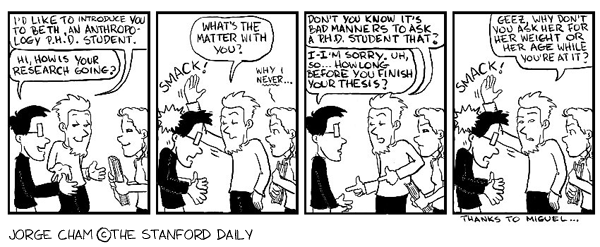
From PHD Comics. (click on image to see it in full resolution)
From PHD Comics. (click on image to see it in full resolution)
Maimonides
I've begun writing a short monthly column for the Or Adam newsletter. Each month, I'll briefly discuss an important thinker in Jewish history or in secular humanist thought. The following was the first "Scholarly Notes" with a focus on Maimonides.
One of the greatest scholars of medieval Jewish history, and arguably of any period, was the Spanish born Moses ben Maimon, better known by his Greek name: Maimonides. Born in Córdoba in 1135, Maimonides eventually settles in Cairo after moving around to escape Muslim persecution and forced conversions of Jews. In Cairo, he rises to prominence as an influential physician and philosopher. He was an expert in Greek philosophy and wrote many secular medical treatises, but his two most famous works are religious in focus: the Mishneh Torah and The Guide to Perplexed. The Mishneh Torah was the Jewish world's first comprehensive law code, integrating laws and rulings from the Tanakh, the Talmuds, Midrashic literature, contemporary rabbinic writings, and even non-Jewish sources like Aristotle. The Guide to the Perplexed seeks to put Jewish law and beliefs on a solid rational basis; that is, he argues that the beliefs were not just the dictates of the Torah or rabbis, but were deduced and proven by reason. In doing so, Maimonides attempts a synthesis of Jewish thinking and Aristotelian philosophy. Although Maimonides' rationalism met much opposition in the Jewish world, many of his views are today taken, at least by the Orthodox, to be defining elements of Judaism. Maimonides also had a profound influence the non-Jewish world. He set the ground for much of later Christian Medieval philosophy: including Thomas Aquinas who attempts, similar to Maimonides' synthesis of Judaism and Aristotelianism, a synthesis of Christianity and Aristotelianism. With Maimonides' attempt to put Jewish thought and beliefs on a rational basis, we should also see him, though quite unintentionally, as setting the stage for later secular Jewish thinking.
Sources: The Teaching Company's Introduction to Judaism by Shai Cherry; A History of the Jews by Paul Johnson; and Wikipedia.
One of the greatest scholars of medieval Jewish history, and arguably of any period, was the Spanish born Moses ben Maimon, better known by his Greek name: Maimonides. Born in Córdoba in 1135, Maimonides eventually settles in Cairo after moving around to escape Muslim persecution and forced conversions of Jews. In Cairo, he rises to prominence as an influential physician and philosopher. He was an expert in Greek philosophy and wrote many secular medical treatises, but his two most famous works are religious in focus: the Mishneh Torah and The Guide to Perplexed. The Mishneh Torah was the Jewish world's first comprehensive law code, integrating laws and rulings from the Tanakh, the Talmuds, Midrashic literature, contemporary rabbinic writings, and even non-Jewish sources like Aristotle. The Guide to the Perplexed seeks to put Jewish law and beliefs on a solid rational basis; that is, he argues that the beliefs were not just the dictates of the Torah or rabbis, but were deduced and proven by reason. In doing so, Maimonides attempts a synthesis of Jewish thinking and Aristotelian philosophy. Although Maimonides' rationalism met much opposition in the Jewish world, many of his views are today taken, at least by the Orthodox, to be defining elements of Judaism. Maimonides also had a profound influence the non-Jewish world. He set the ground for much of later Christian Medieval philosophy: including Thomas Aquinas who attempts, similar to Maimonides' synthesis of Judaism and Aristotelianism, a synthesis of Christianity and Aristotelianism. With Maimonides' attempt to put Jewish thought and beliefs on a rational basis, we should also see him, though quite unintentionally, as setting the stage for later secular Jewish thinking.
Sources: The Teaching Company's Introduction to Judaism by Shai Cherry; A History of the Jews by Paul Johnson; and Wikipedia.
Some changes
In the last month or so, I've started blogging regularly (and simultaneously with Philosophy Blog) at my myspace blog. I've decided that instead of posting the same things on each blog, I want to differentiate the purpose of each. Philosophy Blog will return to its initial purpose: a place for me to blog about philosophically related topics, issues, and questions. All the personal, quirky, silly blogging will go on Myspace Blog, which will also automatically feed into my Facebook profile. There will be occasional crossover blogs, but I will try to keep to this division.
I haven't decided yet if I am going to clean out the non-philosophy related blogs at Philosophy Blog or not. I most likely will keep the older, pre-myspace blogs, but will delete the posts that are duplicated at myspace.
I haven't decided yet if I am going to clean out the non-philosophy related blogs at Philosophy Blog or not. I most likely will keep the older, pre-myspace blogs, but will delete the posts that are duplicated at myspace.
Friday, January 26, 2007
Comic Censorship
My loyal and valued readers will have noticed that I posted a Get Fuzzy comic strip earlier in the week. This strip started a story line of Bucky running for president and sharing his campaign signs with Rob (aka Pinkie) and Satchel. The gag was that Bucky was inadvertently referencing marijuana in his ads. Today's comic, for instance, shows Bucky trying to get the Christian vote with a biblical reference: "Bucky Katt: More Fun than Being Stoned".

I bring this up again because I noticed that the Arizona Republic was running a different set of Get Fuzzy strips. I also spoke to my mother in Boston and the Boston Globe is also not running the Bucky For President story line.
I am outraged at this ridiculous censorship. There is no notice that this strip is different. What else is being censored in the paper without our knowledge? I am going to write the AZ Republic and may even cancel my subscription.

I bring this up again because I noticed that the Arizona Republic was running a different set of Get Fuzzy strips. I also spoke to my mother in Boston and the Boston Globe is also not running the Bucky For President story line.
I am outraged at this ridiculous censorship. There is no notice that this strip is different. What else is being censored in the paper without our knowledge? I am going to write the AZ Republic and may even cancel my subscription.
Thursday, January 25, 2007
For my fellow Sports Guy fans
From The Onion:
Confused Bill Simmons Picks The Departed To Win Super Bowl
LOS ANGELES—Pop-culture enthusiast and sportswriter Bill Simmons, a regular columnist for ESPN's Page 2, was evidently suffering from genre confusion earlier this week when he picked Martin Scorsese's The Departed to win Super Bowl XLI.
Read the rest...
Read Bill Simmons "The Sports Guy".
Confused Bill Simmons Picks The Departed To Win Super Bowl
LOS ANGELES—Pop-culture enthusiast and sportswriter Bill Simmons, a regular columnist for ESPN's Page 2, was evidently suffering from genre confusion earlier this week when he picked Martin Scorsese's The Departed to win Super Bowl XLI.
Read the rest...
Read Bill Simmons "The Sports Guy".
Wednesday, January 24, 2007
More good news on coffee
Study: Coffee May Slow Balding
Just 60 cups a day...
Object lesson: Dose makes the poison (or in this case the cure)
Just 60 cups a day...
Object lesson: Dose makes the poison (or in this case the cure)
Tuesday, January 23, 2007

Sunday, January 21, 2007
Monday, January 15, 2007
Review is published!
My review, referred to in several earlier posts, of Norms of Liberty: A Perfectionist Basis for Non-perfectionist Politics by Douglas Rasmussen and Douglas Den Uyl has been published in the The Independent Review. I've been a fan of 'the Dougs' work for a long time and so it was a great honor and privilege to review their latest work. And Norms of Liberty is a very good and worthwhile book. So, as I do in the review, I recommend it here as well.
Read the review...
Read the review...
Patriots to the AFC Championship Game
I must admit that I think that being a Patriots and Red Sox fan has easily taken 5 years off my life. The level of stress in watching playoff games can't be healthy. But with the Pats returning to the AFC Championship game, it's worth it.
The Pats beat the Chargers yesterday in a hard fought, down in the trenches kind of game. Neither team seemed to be able to get a sustained rhythm going. The Chargers got something going in the first half and got two touchdowns; but the Patriots scored right before the half to keep the game with in 4 and then in the second half the Patriots just seemed to be building while the Chargers seemed to fade: they started to make more mistakes and panic a little. I was surprised to see them move away from the run as much as they did. LT wasn't breaking too many big runs, but he was doing a good job of wearing things down. The Patriots, supremely confident in their ability to win, just kept coming and eventually evened the score and then went ahead on the young rookie kicker's leg.
This game was one of the most stressful games I've ever watched. I swear it was more gut-wrenching than the Super Bowls--but that's probably just because of proximity.
So on to Indy. This will be another battle. The Colts have been, surprisingly, winning with their D the last few games. But this game will be a real test for the Colts. The Ravens had little offensive power and the Chiefs, backing into the playoffs because of Denver's lost, were just not a very good football team this year. They were basically one-dimensionally on offense and so a team like that is going to be stopped in the playoffs. The Patriots are not one dimensional. They can score on the ground or in the air. (Dillion and Maroney combined for 23 yards and the Pats put up 24 points). Manning is always a powerful offensive weapon -- even when he's not playing well. It'll be an exciting, heart-pounding, hair-pulling out game; but I like the Pats chances for a fourth Super Bowl appearance in the Double-O Decade.
I'm also going to go with Saints in the NFC Championship game. I continue to be under-impressed by the Bears; though kudos to Grossman for playing well yesterday.
The Pats beat the Chargers yesterday in a hard fought, down in the trenches kind of game. Neither team seemed to be able to get a sustained rhythm going. The Chargers got something going in the first half and got two touchdowns; but the Patriots scored right before the half to keep the game with in 4 and then in the second half the Patriots just seemed to be building while the Chargers seemed to fade: they started to make more mistakes and panic a little. I was surprised to see them move away from the run as much as they did. LT wasn't breaking too many big runs, but he was doing a good job of wearing things down. The Patriots, supremely confident in their ability to win, just kept coming and eventually evened the score and then went ahead on the young rookie kicker's leg.
This game was one of the most stressful games I've ever watched. I swear it was more gut-wrenching than the Super Bowls--but that's probably just because of proximity.
So on to Indy. This will be another battle. The Colts have been, surprisingly, winning with their D the last few games. But this game will be a real test for the Colts. The Ravens had little offensive power and the Chiefs, backing into the playoffs because of Denver's lost, were just not a very good football team this year. They were basically one-dimensionally on offense and so a team like that is going to be stopped in the playoffs. The Patriots are not one dimensional. They can score on the ground or in the air. (Dillion and Maroney combined for 23 yards and the Pats put up 24 points). Manning is always a powerful offensive weapon -- even when he's not playing well. It'll be an exciting, heart-pounding, hair-pulling out game; but I like the Pats chances for a fourth Super Bowl appearance in the Double-O Decade.
I'm also going to go with Saints in the NFC Championship game. I continue to be under-impressed by the Bears; though kudos to Grossman for playing well yesterday.
Monday, January 08, 2007
Patriots Advance
My New England Patriots beat the Jets on Sunday 37-16 to advance to the next round of the AFC playoffs. They'll face the San Diego Chargers on Sunday afternoon.
The Jets presented a tough challenge for the Pats--the score belies a contested game until the fourth quarter. The Jets have a lot of talent and, now, with Mangini (a former Patriots assistant coach) they are very well coached.
San Diego presents an entirely different challenge. They are so talented on both sides of the ball, they will be tough to stop. Belichick is a master of game planning to stop one player; so I'll imagine they'll scheme to make Rivers beat them rather than their MVP, offensive player of the year running back. Of course, even if they beat the Chargers, the Pats would then have to play either the Ravens or the Colts: neither one a picnic in the park.
On Saturday, I watched the last quarter of the Dallas-Seattle match-up. Dallas had a chance to win but their young quarterback miffed the hold for a field goal and then failed to make the first down or a TD after recovering the ball. A very tough and heart-wrenching way to lose. I had no dog in this race, but I'd hate to be a Dallas fan: my Cowboy fan friend Joe Duarte's response to the game. I do give Romo some credit for immediately picking up the ball on running for the end zone, that was quick thinking and a few inches more and he might have made it. That's what is so great about football: a few inches either way and you can be a hero or a goat.
Divisional Playoffs:
Eagles @ Saints. I'll go with the Saints in this game. They are at home, and the Eagles just barely escaped from the Giants.
Colts @ Ravens. This is tough; a lot of drama to this game. Colts return to Baltimore. Manning against the Ravens D. I'll go with the home team again.
Seattle @ da Bears. Kind of depends on the weather. If it's a typical January in Chicago, no way Seattle wins. Otherwise it could be close, especially if Rex Grossman doesn't control himself. I'll have to go with the home team again.
Pats @ Chargers. I can't be objective here. It'll be tough, but Pats will pull it out in a classic Pats fashion.
The Jets presented a tough challenge for the Pats--the score belies a contested game until the fourth quarter. The Jets have a lot of talent and, now, with Mangini (a former Patriots assistant coach) they are very well coached.
San Diego presents an entirely different challenge. They are so talented on both sides of the ball, they will be tough to stop. Belichick is a master of game planning to stop one player; so I'll imagine they'll scheme to make Rivers beat them rather than their MVP, offensive player of the year running back. Of course, even if they beat the Chargers, the Pats would then have to play either the Ravens or the Colts: neither one a picnic in the park.
On Saturday, I watched the last quarter of the Dallas-Seattle match-up. Dallas had a chance to win but their young quarterback miffed the hold for a field goal and then failed to make the first down or a TD after recovering the ball. A very tough and heart-wrenching way to lose. I had no dog in this race, but I'd hate to be a Dallas fan: my Cowboy fan friend Joe Duarte's response to the game. I do give Romo some credit for immediately picking up the ball on running for the end zone, that was quick thinking and a few inches more and he might have made it. That's what is so great about football: a few inches either way and you can be a hero or a goat.
Divisional Playoffs:
Eagles @ Saints. I'll go with the Saints in this game. They are at home, and the Eagles just barely escaped from the Giants.
Colts @ Ravens. This is tough; a lot of drama to this game. Colts return to Baltimore. Manning against the Ravens D. I'll go with the home team again.
Seattle @ da Bears. Kind of depends on the weather. If it's a typical January in Chicago, no way Seattle wins. Otherwise it could be close, especially if Rex Grossman doesn't control himself. I'll have to go with the home team again.
Pats @ Chargers. I can't be objective here. It'll be tough, but Pats will pull it out in a classic Pats fashion.
Tuesday, January 02, 2007
A Puzzle of Mystery
Malcolm Gladwell, author of Blink! and The Tipping Point, has a very interesting article over at The New Yorker.
Drawing on a distinction, attributed to national-security expert Gregory Treverton, between a puzzle and a mystery, Gladwell offers an analysis of Enron and the Iraqi war. The distinction is essentially this: A puzzle is a problem that is solved by finding more information. When the information is in place, the puzzle is solved (or the solution is clear). A mystery is something different. It's not a matter of missing information, it's a matter of how one puts the information together.
So Enron and Iraq were (are) mysteries; there was no clear cut solution that was only out of reach because we lacked information. The information was there, it was how the information was understood that mattered.
Gladwell describes how Enron's business model and accounting procedures were out there to be seen. In fact, he refers to a 1998 Cornell business school project where six students correctly identified that Enron's practices were risky, dubious, and possibly manipulative. Other financial reports found similar things. Both found this information in public documents.
So the 'problem of Enron' was not a puzzle. It was a mystery: figuring out what was going on and what was going to happen required complicated and thorough analysis of the information already available (we didn't need more disclosure, we needed better understanding of what was disclosed). Getting the right conclusion was an exercise in good judgment, require experience and sometimes specialized knowledge.
Iraq is similar in that understanding what was going on prior to invasion as well as predicting the consequences required analyzing countless bits of information and putting them together in the appropriate ways. This in part explains the great divergence of viewpoints and visions on pre-invasion and post-invasion Iraq: People are looking at the information and seeing different things.
Gladwell doesn't offer any solutions or proposals, just an interesting analysis of how the way one looks at a problem (is it a puzzle or a mystery) is deeply relevant to one's success. In a puzzle, one needed more information. In a mystery, one needs comprehension of the information one already has. So looking at a problem as one or the other will counsel different courses of action.
A few thoughts:
Drawing on a distinction, attributed to national-security expert Gregory Treverton, between a puzzle and a mystery, Gladwell offers an analysis of Enron and the Iraqi war. The distinction is essentially this: A puzzle is a problem that is solved by finding more information. When the information is in place, the puzzle is solved (or the solution is clear). A mystery is something different. It's not a matter of missing information, it's a matter of how one puts the information together.
So Enron and Iraq were (are) mysteries; there was no clear cut solution that was only out of reach because we lacked information. The information was there, it was how the information was understood that mattered.
Gladwell describes how Enron's business model and accounting procedures were out there to be seen. In fact, he refers to a 1998 Cornell business school project where six students correctly identified that Enron's practices were risky, dubious, and possibly manipulative. Other financial reports found similar things. Both found this information in public documents.
So the 'problem of Enron' was not a puzzle. It was a mystery: figuring out what was going on and what was going to happen required complicated and thorough analysis of the information already available (we didn't need more disclosure, we needed better understanding of what was disclosed). Getting the right conclusion was an exercise in good judgment, require experience and sometimes specialized knowledge.
Iraq is similar in that understanding what was going on prior to invasion as well as predicting the consequences required analyzing countless bits of information and putting them together in the appropriate ways. This in part explains the great divergence of viewpoints and visions on pre-invasion and post-invasion Iraq: People are looking at the information and seeing different things.
Gladwell doesn't offer any solutions or proposals, just an interesting analysis of how the way one looks at a problem (is it a puzzle or a mystery) is deeply relevant to one's success. In a puzzle, one needed more information. In a mystery, one needs comprehension of the information one already has. So looking at a problem as one or the other will counsel different courses of action.
A few thoughts:
- One wonders after reading Gladwell, exactly what Enron did that was explicitly criminal? I am not apologizing (I know little about the facts of the case, so this is just speculation) for Enron, but it seems like, according to Gladwell, they followed the accounting and reporting rules pretty much as they should but got caught in their own complicated web of financial tools (that they barely understood themselves) and collapsed. They may have been deceptive but did they violate state or federal laws? It strikes me, at least following Gladwell's account, that they got into some shady areas that was just enough to hang them on, but had they not been as big or caused so much financial disruption, they would have gotten off with some fines or more minor sentences.
- The puzzle/mystery distinction might be interesting as a way of distinguishing science and philosophy. Science is about puzzles: finding the facts and collecting information. Problem-solving is largely a matter of getting better information. Philosophy is about mysteries: taking the information and conceptualizing; putting it together in a way that makes the best sense of the information. Problem-solving here is a matter of honing one's judgment.
Friday, December 22, 2006
Rabbis without God
The Jerusalem Post is reporting:
A hat tip to Jack Silver by way of my wife for this news.
"In an unprecedented event in Israel, seven secular Jews who view Judaism as a culture, as opposed to a religion, will be ordained as rabbis Friday in Jerusalem."As the few and brave readers of this blog know, I am involved in a local Secular Jewish congregation--one that is a related organization to the one that is doing the ordaining in Israel: International Institute for Secular Humanistic Judaism--so this is good to hear.
A hat tip to Jack Silver by way of my wife for this news.
Philosophy of Ambiguity
My uncle sent these to me and I thought many of them where funny enough to pass along:
1. Don't sweat the petty things and don't pet the sweaty things.
2. One tequila, two tequila, three tequila, floor....
3. Atheism is a non-prophet organization.
4. If man evolved from monkeys and apes, why do we still have monkeys and apes?
5. The main reason Santa is so jolly is because he knows where all the bad girls live.
6. I went to a bookstore and asked the saleswoman, "Where's the self-help section?" She said if she told me, it would defeat the purpose.
7. What if there were no hypothetical questions?
8. If a deaf person swears, does his mother wash his hands with soap?
9. If someone with multiple personalities threatens to kill himself, is it considered a hostage situation?
10. Is there another word for synonym?
11. Where do forest rangers go to "get away from it all?"
12. What do you do when you see an endangered animal eating an endangered plant?
13. If a parsley farmer is sued, can they garnish his wages?
14. Would a fly without wings be called a walk?
15 Why do they lock gas station bathrooms? Are they afraid someone will clean them?
16. If a turtle doesn't have a shell, is he homeless or naked?
17. Can vegetarians eat animal crackers?
18. If the police arrest a mime, do they tell him he has the right to remain silent?
19. Why do they put Braille on the drive-through bank machines?
20. How do they get deer to cross the road only at those yellow road signs?
21. What was the best thing before sliced bread?
22. One nice thing about egotists: They don`t talk about other people.
23. Does the Little Mermaid wear an algebra?
24. Do infants enjoy infancy as much as adults enjoy adultery?
25. How is it possible to have a civil war?
26. If one synchronized swimmer drowns, do the rest drown too?
27. If you ate both pasta and antipasto, would you still be hungry?
28. If you try to fail, and succeed, which have you done?
29. Whose cruel idea was it for the word "Lisp" to have "S" in it?
30. Why are hemorrhoids called "hemorrhoids" instead of "assteroids"?
31. Why is it called tourist season if we can't shoot at them?
32. Why is there an expiration date on sour cream?
33. If you spin an oriental man in a circle three times does he become disoriented?
34. Can an atheist get insurance against acts of God?
1. Don't sweat the petty things and don't pet the sweaty things.
2. One tequila, two tequila, three tequila, floor....
3. Atheism is a non-prophet organization.
4. If man evolved from monkeys and apes, why do we still have monkeys and apes?
5. The main reason Santa is so jolly is because he knows where all the bad girls live.
6. I went to a bookstore and asked the saleswoman, "Where's the self-help section?" She said if she told me, it would defeat the purpose.
7. What if there were no hypothetical questions?
8. If a deaf person swears, does his mother wash his hands with soap?
9. If someone with multiple personalities threatens to kill himself, is it considered a hostage situation?
10. Is there another word for synonym?
11. Where do forest rangers go to "get away from it all?"
12. What do you do when you see an endangered animal eating an endangered plant?
13. If a parsley farmer is sued, can they garnish his wages?
14. Would a fly without wings be called a walk?
15 Why do they lock gas station bathrooms? Are they afraid someone will clean them?
16. If a turtle doesn't have a shell, is he homeless or naked?
17. Can vegetarians eat animal crackers?
18. If the police arrest a mime, do they tell him he has the right to remain silent?
19. Why do they put Braille on the drive-through bank machines?
20. How do they get deer to cross the road only at those yellow road signs?
21. What was the best thing before sliced bread?
22. One nice thing about egotists: They don`t talk about other people.
23. Does the Little Mermaid wear an algebra?
24. Do infants enjoy infancy as much as adults enjoy adultery?
25. How is it possible to have a civil war?
26. If one synchronized swimmer drowns, do the rest drown too?
27. If you ate both pasta and antipasto, would you still be hungry?
28. If you try to fail, and succeed, which have you done?
29. Whose cruel idea was it for the word "Lisp" to have "S" in it?
30. Why are hemorrhoids called "hemorrhoids" instead of "assteroids"?
31. Why is it called tourist season if we can't shoot at them?
32. Why is there an expiration date on sour cream?
33. If you spin an oriental man in a circle three times does he become disoriented?
34. Can an atheist get insurance against acts of God?
Thursday, December 21, 2006
Deathly Hallows
Rowling has announced the title to her next and last Harry Potter book: Harry Potter and the Deathly Hallows. Sounds a tad ominous, no?
The article from the BBC has some interesting quotes from Rowling about her mixed emotions on finishing the last book.
http://news.bbc.co.uk/1/hi/entertainment/6200745.stm
Hat tip to my beautiful wife.
The article from the BBC has some interesting quotes from Rowling about her mixed emotions on finishing the last book.
http://news.bbc.co.uk/1/hi/entertainment/6200745.stm
Hat tip to my beautiful wife.
Friday, December 15, 2006
Thursday, December 14, 2006
Hanukkah Rocks Review
Here's my review, written for the Or Adam newsletter, of The LeeVee's Hanukkah Rocks CD.
Just how do you spell Hanukkah? And is it apple sauce or sour cream for your latkes? These are the question posed by The LeeVees in their holiday album: Hanukkah Rocks. Adam Gardner and Dave Schneider combine for this fun, contemporary, and entertaining album of new Hanukkah songs. Released in October 2005, Hanukkah Rocks seeks to fill a gap in Hanukkah music. Outside of the ubiquitous "Driedel Song", there aren't too many songs out there for Hanukkah. Gardner and Schneider, both established musicians with their respective bands (Guster and The Zambonis), successfully fill this void with sure to be classics like "Latke Clan": "We'll put the oil into the pan/So come and join our Latke Clan/'Cause we are latke fans" and the hilarious "How Do You Spell Channukkahh?": "I remember when I was/In Elementary School/A Spanish kid told me/that it starts with a silent J/But Julio was wrong". These songs capture the secular sense of Hanukkah that connects most Jews to the holiday, but they are also good enough to listen to year round. Other songs are about the love for kugel, the adventure of the Jewish Matzoh Ball, and the unofficial Jewish tradition of going for Chinese food on Christmas day. The album is often amusing and always fun; and furthermore, full of the joy of being Jewish.
Hanukkah Rocks, Reprise Records
Available online at www.theleevees.com
Monday, December 04, 2006
My American Accent
Hat tip to Philosopher Stone for this. His, he asserts, was dead on. As for me, not quite. Maybe I over thought questions...
| What American accent do you have? Your Result: The Midland "You have a Midland accent" is just another way of saying "you don't have an accent." You probably are from the Midland (Pennsylvania, southern Ohio, southern Indiana, southern Illinois, and Missouri) but then for all we know you could be from Florida or Charleston or one of those big southern cities like Atlanta or Dallas. You have a good voice for TV and radio. | |
| The West | |
| Boston | |
| North Central | |
| The Inland North | |
| Philadelphia | |
| The Northeast | |
| The South | |
| What American accent do you have? Take More Quizzes | |
Sunday, December 03, 2006
More Updates...
Some other items of interest (to me at least):
1. Saw the new Bond movie on Saturday. Daniel Craig is fantastic as Bond. Bronson brought a lot of romantic elements back to Bond after Dalton's more naturalistic portrayal, but Craig, and the movie as a whole, really brings out the true romanticism of the character and the story. Bond is a true hero in a grand adventure; and the movie avoids the cynicism and cheesiness that often accompany such films. One gets the feeling that this must have been what it was like to have seen Dr. No with Sean Connery for the first time in the theaters. The rest of the cast is quite good as well. I am looking forward to next Bond already.
2. Kristen and I have been listening with our friends Amy and Michael to the Teaching Company's: Introduction to Judaism course. We listen to the tapes and then go over the discussion questions and other issues raised by the lecture. A much more effective method than just listening as I walk the dog half a sleep in at 6am. We are almost done with the course and will then listen to Jewish Intellectual History.
3. We've started an Or Adam Book Club. We're going to start in February and then meet every two months. All the books will have Jewish theme or focus of some kind. The first book is The Song of Hannah by Eva Etzioni-Halevy. One of the other books we are doing is Betraying Spinoza by Rebecca Goldstein. It's a biography of Spinoza, but Goldstein is a philosopher and so I expect it to get into his ideas. I know little of Spinoza, and so this will be a good opportunity to pick up a little more.
1. Saw the new Bond movie on Saturday. Daniel Craig is fantastic as Bond. Bronson brought a lot of romantic elements back to Bond after Dalton's more naturalistic portrayal, but Craig, and the movie as a whole, really brings out the true romanticism of the character and the story. Bond is a true hero in a grand adventure; and the movie avoids the cynicism and cheesiness that often accompany such films. One gets the feeling that this must have been what it was like to have seen Dr. No with Sean Connery for the first time in the theaters. The rest of the cast is quite good as well. I am looking forward to next Bond already.
2. Kristen and I have been listening with our friends Amy and Michael to the Teaching Company's: Introduction to Judaism course. We listen to the tapes and then go over the discussion questions and other issues raised by the lecture. A much more effective method than just listening as I walk the dog half a sleep in at 6am. We are almost done with the course and will then listen to Jewish Intellectual History.
3. We've started an Or Adam Book Club. We're going to start in February and then meet every two months. All the books will have Jewish theme or focus of some kind. The first book is The Song of Hannah by Eva Etzioni-Halevy. One of the other books we are doing is Betraying Spinoza by Rebecca Goldstein. It's a biography of Spinoza, but Goldstein is a philosopher and so I expect it to get into his ideas. I know little of Spinoza, and so this will be a good opportunity to pick up a little more.
Update
To my loyal readers, if there are any, it is time for an update on what I've been up to.
I've applied for several full-time teaching jobs for Fall 2007. Mostly Northeastern schools; small liberal arts colleges with a strong emphasis on undergraduate education. I think that is the kind of school I'd be happiest at, and moreover, I think that kind of education environment is, for most students, the most beneficial and rewarding. I'll be attending the Eastern APA meeting in DC; I am hopeful that I'll have some interviews. For those outside of the philosophy world: the Eastern APA conference is both a philosophy conference with presentations and the like but it also the main stage for the first round of job interviews.
The dissertation is under way, and I am targeting finishing in May. A bit on the aggressive side, but my chair and I are confident and optimistic. We have worked out a plan that is doable.
Part of the dissertation involves using characters from Robert Parker's Spenser series. I am using the characters of Spenser and Hawk to focus the questions and problems of Practical Wisdom that the dissertation is focused on. As such, I am reading several of the novels so that they are more fresh in mind.
I've applied for several full-time teaching jobs for Fall 2007. Mostly Northeastern schools; small liberal arts colleges with a strong emphasis on undergraduate education. I think that is the kind of school I'd be happiest at, and moreover, I think that kind of education environment is, for most students, the most beneficial and rewarding. I'll be attending the Eastern APA meeting in DC; I am hopeful that I'll have some interviews. For those outside of the philosophy world: the Eastern APA conference is both a philosophy conference with presentations and the like but it also the main stage for the first round of job interviews.
The dissertation is under way, and I am targeting finishing in May. A bit on the aggressive side, but my chair and I are confident and optimistic. We have worked out a plan that is doable.
Part of the dissertation involves using characters from Robert Parker's Spenser series. I am using the characters of Spenser and Hawk to focus the questions and problems of Practical Wisdom that the dissertation is focused on. As such, I am reading several of the novels so that they are more fresh in mind.
Saturday, October 14, 2006
I guess the French aren't that bad
Good news came in the mail today. Harry Potter and Philosophy has been translated into French: Harry Potter et la Philosophie.
For those keeping track, that means I've been translated into Portuguese, Korean, and French.
For those keeping track, that means I've been translated into Portuguese, Korean, and French.
Thursday, September 21, 2006
Official: Jolie is Dagny
According to Variety magazine, Angelina Jolie has signed with Lionsgate to portray Dagny Taggart in the film adapation of Rand’s classic, Atlas Shrugged.
Click here to read more at Variety.com
Click here to read The Atlas Society’s announcement
Still no word on a director yet, but signing Jolie is a big step.
Click here to read more at Variety.com
Click here to read The Atlas Society’s announcement
Still no word on a director yet, but signing Jolie is a big step.
Saturday, September 16, 2006
The best logical fallacies
By way of Philosopher Stone, GeekPress has a list of logical fallacies: each one with an argument for why it is the best logical fallacy. Here's the rub: each one of these arguments commits the fallacy that it claims is the best. Very funny.
Monday, September 11, 2006
Posting Dirth
For the few who actually read this blog, I apologize for the dirth of posting. I am working hard on preparing for my comprehensive exam in early October. All my energy and attention is being focused on this task.
A few quick hits:
1. I am excited about the start of football season, though I won't really be able to watch the first month of games. I did watch the ugly win by the Pats yesterday. A win is a win is win. Positives: running game looks awesome. Defense looks sharp, but had some troubles getting going. Negatives: um, a wide receiver would be nice.
2. Deion Branch trade to Seattle. Sad to see him go; concerned about Pats WR situation; but overall hard to argue against Team Belichick. I am hoping Gabriel will step up and be the deep threat we need.
3. Comps preps lately has been focused on Julia Annas' work. Prior to Annas, I was reading through Sarah Broadie--another top Aristotle scholar. The contrast in style and approach is striking. Annas is more of a generalist, at least in The Morality of Happiness. She is looking at the whole of ancient ethics. Broadie is super-detailed, giving an indepth and close analysis of Aristotle. Both are important scholarly tactics, and both are important for my project of looking at the development of Practical Wisdom from Aristotle to contemporary virtue ethics.
4. This afternoon, I am reading Kant's Doctrine of the Virtues. I am excited, because this is totally new material, but a bit anxious, because it's going to be a tough slog through difficult material.
5. On my morning Bella walks, I have been listening to Robert Greenberg's How to listen to and understand Opera (Teaching Co.). Almost half way through. Very, very good--but then it's the Teaching Co. so that goes without saying. (But I said it anyway, go figure)
6. I can't believe it's been 5 years since 9/11. I can still clearly remember Tim announcing, as we settled into work, to the office in Poughkeepsie, NY: "The World Trade Center tower has been hit by an airplane". We thought at first it was a freak accident. Then the second tower was hit: now it was clear that it was a terrorist attack.
Well, that's probably too long a break...back to work...
A few quick hits:
1. I am excited about the start of football season, though I won't really be able to watch the first month of games. I did watch the ugly win by the Pats yesterday. A win is a win is win. Positives: running game looks awesome. Defense looks sharp, but had some troubles getting going. Negatives: um, a wide receiver would be nice.
2. Deion Branch trade to Seattle. Sad to see him go; concerned about Pats WR situation; but overall hard to argue against Team Belichick. I am hoping Gabriel will step up and be the deep threat we need.
3. Comps preps lately has been focused on Julia Annas' work. Prior to Annas, I was reading through Sarah Broadie--another top Aristotle scholar. The contrast in style and approach is striking. Annas is more of a generalist, at least in The Morality of Happiness. She is looking at the whole of ancient ethics. Broadie is super-detailed, giving an indepth and close analysis of Aristotle. Both are important scholarly tactics, and both are important for my project of looking at the development of Practical Wisdom from Aristotle to contemporary virtue ethics.
4. This afternoon, I am reading Kant's Doctrine of the Virtues. I am excited, because this is totally new material, but a bit anxious, because it's going to be a tough slog through difficult material.
5. On my morning Bella walks, I have been listening to Robert Greenberg's How to listen to and understand Opera (Teaching Co.). Almost half way through. Very, very good--but then it's the Teaching Co. so that goes without saying. (But I said it anyway, go figure)
6. I can't believe it's been 5 years since 9/11. I can still clearly remember Tim announcing, as we settled into work, to the office in Poughkeepsie, NY: "The World Trade Center tower has been hit by an airplane". We thought at first it was a freak accident. Then the second tower was hit: now it was clear that it was a terrorist attack.
Well, that's probably too long a break...back to work...
Friday, July 28, 2006
Consumerism in Education
As an educator, I read articles on education: its current state, where it’s going, style’s of teaching, etc. Often these articles refer, derisively, to the creep of consumerism into education. The complaint is that too many students have the view that since they are paying for the class, they should get an A or more direct control over the classroom itself. In my experience there is a lot of truth to this complaint; many students do have this view.
The complaint is, however, misplaced. The consumerism of the students, per se, doesn’t bother me or strike me as problematic. After all, education is a service that is being sold. Students are buying (and consuming) this service. Indeed, I often think of myself qua teacher as an entrepreneur. Consumerism becomes problematic in education when students (and others: parents, administrators, educators, politicians, etc.) have the wrong idea of what is being consumed.
When students view their purchase as the purchase of an A or even the purchase of an ‘education’, they are misunderstanding (with partial culpability to the institutions themselves) their purchase. Educational institutions are selling access and opportunity for education; the student has to get that education himself. An analogy to personal fitness training is apt here. If Sally purchases a year of personal fitness training at her local gym, she is not buying fitness; she is buying access to a trainer who has knowledge about fitness and can direct her efforts towards her goals. She is buying the access to facilities and equipment. She is purchasing the opportunity to get herself fit. If Sally became upset because the trainer was pushing her and challenging her during her sessions or because she failed to reach her fitness goals due to her own sloth or lack of effort then Sally is seriously misplacing her disappointment.
The same applies for education. When Tommy pays tuition at an education institution he is purchasing access to experts who can direct him towards his goals (and even help him determine these goals); he is purchasing access to facilities such as libraries and research centers. He is buying the opportunity to get an education, but he has to work to achieve these goals, much like Sally has to work to achieve her fitness goals.
If more students viewed education in this way, consumerism would be a benefit to them and to educators. Paying for one’s own education provides a powerful incentive to actually do the work that will help in achieving one’s goals. Even for the more apathetic students, I think the attitude would shift from “I paid for the credits, give me the A” to “I paid for the credits, I better do something about it”. This would be similar to the experience many have after buying a gym membership: “well, I paid for the membership; I might as well make use of it”.
So what causes students to have the wrong idea about what they are buying? The causes are many. In part, I think the institutions themselves contribute to this with the way they sell their services (either to students directly or the taxpayers that are actually paying for the education) and the way they structure their institutions. I think politicians represent a college education in this way—as some consumable that needs to be distributed to each member of society. The drive to get everyone a college education means that many students at colleges don’t want to be there (at least not for the right reasons), but are there because of incentives, parental or social pressures, and the like. They are told they need to get a college diploma to get a good job and so they want a college diploma. Many student, thus, don’t want (or care about) an education; they just want the document that says they can now get a good job. In other words, they want a union card, not an education.
I am not sure how to break this attitude. But, I think a start is for educators to do a better job of setting the right expectations for students.
The complaint is, however, misplaced. The consumerism of the students, per se, doesn’t bother me or strike me as problematic. After all, education is a service that is being sold. Students are buying (and consuming) this service. Indeed, I often think of myself qua teacher as an entrepreneur. Consumerism becomes problematic in education when students (and others: parents, administrators, educators, politicians, etc.) have the wrong idea of what is being consumed.
When students view their purchase as the purchase of an A or even the purchase of an ‘education’, they are misunderstanding (with partial culpability to the institutions themselves) their purchase. Educational institutions are selling access and opportunity for education; the student has to get that education himself. An analogy to personal fitness training is apt here. If Sally purchases a year of personal fitness training at her local gym, she is not buying fitness; she is buying access to a trainer who has knowledge about fitness and can direct her efforts towards her goals. She is buying the access to facilities and equipment. She is purchasing the opportunity to get herself fit. If Sally became upset because the trainer was pushing her and challenging her during her sessions or because she failed to reach her fitness goals due to her own sloth or lack of effort then Sally is seriously misplacing her disappointment.
The same applies for education. When Tommy pays tuition at an education institution he is purchasing access to experts who can direct him towards his goals (and even help him determine these goals); he is purchasing access to facilities such as libraries and research centers. He is buying the opportunity to get an education, but he has to work to achieve these goals, much like Sally has to work to achieve her fitness goals.
If more students viewed education in this way, consumerism would be a benefit to them and to educators. Paying for one’s own education provides a powerful incentive to actually do the work that will help in achieving one’s goals. Even for the more apathetic students, I think the attitude would shift from “I paid for the credits, give me the A” to “I paid for the credits, I better do something about it”. This would be similar to the experience many have after buying a gym membership: “well, I paid for the membership; I might as well make use of it”.
So what causes students to have the wrong idea about what they are buying? The causes are many. In part, I think the institutions themselves contribute to this with the way they sell their services (either to students directly or the taxpayers that are actually paying for the education) and the way they structure their institutions. I think politicians represent a college education in this way—as some consumable that needs to be distributed to each member of society. The drive to get everyone a college education means that many students at colleges don’t want to be there (at least not for the right reasons), but are there because of incentives, parental or social pressures, and the like. They are told they need to get a college diploma to get a good job and so they want a college diploma. Many student, thus, don’t want (or care about) an education; they just want the document that says they can now get a good job. In other words, they want a union card, not an education.
I am not sure how to break this attitude. But, I think a start is for educators to do a better job of setting the right expectations for students.
Monday, July 17, 2006
Kristol: It's Our War
William Kristol, of the Weekly Standard, has a good piece on why Israel's fight with Hizbollah is part of the wider struggle against Islamo-fascism; that is, the US (and the West) against Iran.
Friday, July 14, 2006
Just call me Prez
According to this website, the celebrities I most resemble are Sean Astin, Haley Osment, Gabriel Bryne, Ronaldo, Lance Armstrong, Patrick Swayze, George W Bush, Matt Dillon, Lee Harvey Oswald, and Matt Ruffalo. I've gotten Matt Dillon before...but Oswald?? Do I look like a crazied patsy assassin?
Hat tip to Joe 'Hilary Duff' Duarte for the website.
Hat tip to Joe 'Hilary Duff' Duarte for the website.
Wednesday, July 12, 2006
Good News!
My review of Douglas Rasmussen and Douglas Den Uyl's Norms of Liberty is scheduled to be published by The Independent Review in their Winter 2007 issue (mailed in December). Yippie!
Some What I am Reading Updates
I finished the biography of Belichick. A very good read with lots of interesting information about the development of the team, and of Belichick as a coach. I would have like to have seen more in the later years where he was building and coaching the Patriots. It was much more focused on his earlier years--but given the title (The Education of a Coach) of the book that makes sense.
I started Parker's "Blue Screen", the latest Sunny Randall. So far, so good. She meets Jesse Stone, and the book starts off recalling some events from the Spenser book where Spenser meets Jesse. So these are all the same universe, so it's only a matter of time before Sunny and Spenser meet.
I started Parker's "Blue Screen", the latest Sunny Randall. So far, so good. She meets Jesse Stone, and the book starts off recalling some events from the Spenser book where Spenser meets Jesse. So these are all the same universe, so it's only a matter of time before Sunny and Spenser meet.
Monday, July 10, 2006
Seminar Comments and Follow-up
Just got back from TOC’s Summer Seminar at Chapman University. I had a wonderful week and the seminar was excellent. The program was top-notch this year, with not a single presentation (save one) that I was disappointed in. I reconnected with old friends and made several new ones.
The big event of this year’s program was of course the ‘meet n’ greet’ with Howard and Karen Baldwin. The Baldwin’s are the principals of the Baldwin Entertainment Group (of Ray fame) which is producing the Atlas Shrugged movie. For more than an hour, the Baldwin’s graciously fielded questions from the crowd which was eager to give its suggestions (both positive and negative). I was very impressed with the Baldwins, in particular Karen Baldwin. They appear to be fully committed to making this movie--and more importantly making it right.
Now that they have signed with Lionsgate for distribution and production, the next step is to hire a director and then start to do casting. They said they are talking to directors, Vadim Perelman (House of Sand and Fog) as the one name I can remember. I have heard mostly good things about House of Sand and Fog, but I’ve never seen it. They also appear very close to casting Angelina Jolie for Dagny--they apparently have had many conversations with her about it. I know many would not be happy with this choice--but Jolie can pull it off and she’ll drive audiences to the theaters world wide.
One last tidbit about the Atlas movie: they are planning a trilogy, with the first part to beginning filming in the Spring.
The two best talks I attended: Tim Sandefur’s Eminent Domain Abuse: Its Philosophical Roots; and Susan Wake’s Overcoming Ethical Relativism in the College Classroom.
I didn’t attend Barbara Branden’s Rage and Objectivism; but I heard nothing but good things about it. Another talk I didn’t attend but which was very well received was Bidinotto’s The Anatomy of Cooperation. I’ve ordered both audios, so I hope to find out what I missed.
The one disappointing session was the joint interview of the Brandens by Duncan Scott. I wasn’t sure of the point of the session prior to going, and I am still not. The questions were for the most part uninteresting and basically softballs; there was nothing said that hadn’t already been said a hundred times before. As a philosopher, I will be glad when Objectivism can be discussed and studied without having to deal with irrelevancies from 40 years ago. Let’s get down to the business of understanding philosophy and making our lives happier and more prosperous.
All in all, a great conference and a great week.
The big event of this year’s program was of course the ‘meet n’ greet’ with Howard and Karen Baldwin. The Baldwin’s are the principals of the Baldwin Entertainment Group (of Ray fame) which is producing the Atlas Shrugged movie. For more than an hour, the Baldwin’s graciously fielded questions from the crowd which was eager to give its suggestions (both positive and negative). I was very impressed with the Baldwins, in particular Karen Baldwin. They appear to be fully committed to making this movie--and more importantly making it right.
Now that they have signed with Lionsgate for distribution and production, the next step is to hire a director and then start to do casting. They said they are talking to directors, Vadim Perelman (House of Sand and Fog) as the one name I can remember. I have heard mostly good things about House of Sand and Fog, but I’ve never seen it. They also appear very close to casting Angelina Jolie for Dagny--they apparently have had many conversations with her about it. I know many would not be happy with this choice--but Jolie can pull it off and she’ll drive audiences to the theaters world wide.
One last tidbit about the Atlas movie: they are planning a trilogy, with the first part to beginning filming in the Spring.
The two best talks I attended: Tim Sandefur’s Eminent Domain Abuse: Its Philosophical Roots; and Susan Wake’s Overcoming Ethical Relativism in the College Classroom.
I didn’t attend Barbara Branden’s Rage and Objectivism; but I heard nothing but good things about it. Another talk I didn’t attend but which was very well received was Bidinotto’s The Anatomy of Cooperation. I’ve ordered both audios, so I hope to find out what I missed.
The one disappointing session was the joint interview of the Brandens by Duncan Scott. I wasn’t sure of the point of the session prior to going, and I am still not. The questions were for the most part uninteresting and basically softballs; there was nothing said that hadn’t already been said a hundred times before. As a philosopher, I will be glad when Objectivism can be discussed and studied without having to deal with irrelevancies from 40 years ago. Let’s get down to the business of understanding philosophy and making our lives happier and more prosperous.
All in all, a great conference and a great week.
Wednesday, June 21, 2006
Guster: Ganging Up on The Sun
Guster has a new album out: Ganging Up on The Sun. I've been listening to it quite a bit in the last few days (It arrived on Monday).
This album is very different than previous Guster albums: a different sound, one much more eclectic, though at times too conventional/poppy. The biggest difference in the sound is the lack of Brian's bongos. I really miss them, and I found some of the songs a bit on the plain/conventional side without them.
The first two songs are also too mellow and don't set the right tone for the rest of the album. I've found that if I start on the third track, the whole album sounds better.
I've also noticed a lot of musical influences. Some of the songs have a very Beatlesque sound; a few others were reminsicent of Asia (or more poppy Yes). One Song, Ruby Falls -- one of the songs I really like -- even has a Grateful Dead a la Terrapin Station thing going on.
The Captain is a song with a lot of that Guster energy. Manifest Destiny was an early release track, so I have heard it before; it too has a lot of that Guster energy. The New Underground is a song with some early 80's Yes overtones. I'll have more comments on the songs later after I listen to them more.
Like with the last few albums, I've found that you have to listen to the album a number of times to get a feel for it before you can really judge it. The songs have a tendency to grow on you and get better. I think this is in part to their exploration of a new sound (especially as the bongos have been fading out). It's a bit like that adage about fighting the last war. When you first come to listen to the album, you are still thinking of the past album and that colors the way you react to the new album. Once you get the new album in your system on its own terms, you are able to judge it.
Overall, it's no Parachute or Lost and Gone, but I like the album and I am looking forward to listening to it more.
This album is very different than previous Guster albums: a different sound, one much more eclectic, though at times too conventional/poppy. The biggest difference in the sound is the lack of Brian's bongos. I really miss them, and I found some of the songs a bit on the plain/conventional side without them.
The first two songs are also too mellow and don't set the right tone for the rest of the album. I've found that if I start on the third track, the whole album sounds better.
I've also noticed a lot of musical influences. Some of the songs have a very Beatlesque sound; a few others were reminsicent of Asia (or more poppy Yes). One Song, Ruby Falls -- one of the songs I really like -- even has a Grateful Dead a la Terrapin Station thing going on.
The Captain is a song with a lot of that Guster energy. Manifest Destiny was an early release track, so I have heard it before; it too has a lot of that Guster energy. The New Underground is a song with some early 80's Yes overtones. I'll have more comments on the songs later after I listen to them more.
Like with the last few albums, I've found that you have to listen to the album a number of times to get a feel for it before you can really judge it. The songs have a tendency to grow on you and get better. I think this is in part to their exploration of a new sound (especially as the bongos have been fading out). It's a bit like that adage about fighting the last war. When you first come to listen to the album, you are still thinking of the past album and that colors the way you react to the new album. Once you get the new album in your system on its own terms, you are able to judge it.
Overall, it's no Parachute or Lost and Gone, but I like the album and I am looking forward to listening to it more.
Condi
Andrew Sullivan -- always an interesting and entertaining read -- has an article up UK Times about Condi Rice and how her influence in the White House is apparently gaining. I don't know that much about Rice, but something about her impresses me. Though not aggressive in the public eye, she seems like a very tough cookie with brains to back it up.
I think there is a high probablity that Condi will be at least the VP candidate in 2008, especially if Hillary is on the Dems ticket.
I think there is a high probablity that Condi will be at least the VP candidate in 2008, especially if Hillary is on the Dems ticket.
Wednesday, June 14, 2006
Harry Potter e a filosofia
This is old news, but I had not yet posted it. Harry Potter and Philosophy is available in a Spanish Portuguse language edition as Harry Potter e a Filosofia. (Update 6/18: So much for my knowledge of Spanish--this is Portuguese!)
It's also now available in a Korean language edition. I couldn't find a link to this though--not that I could read it anyway!
It's also now available in a Korean language edition. I couldn't find a link to this though--not that I could read it anyway!
Sunday, June 11, 2006
Updates (or why I've disappeared)
PhD update: I've moved comps prep to the back burner to work on some other projects. But next up is an essay by Hilary Putnam and Christine Swanton's book: Virtue Ethics
Summer Seminar update: I am plugging away at my 3-part talk on Locke, Hume, and Rand. I'll be giving an abridged version of this talk at AO on June 24th.
Norms of Liberty review update: I've got some more revisions to do on this review before I send it to The Independent Review.
Teaching Company update: I've started watching the Argumentation: The Study of Effective Reasoning course. So far, it's interesting. Fairly basic stuff, but that's what I expected.
I will be teaching ASU's "Principles of Sound Reasoning" course this summer--so I thought watching this course would be a nice refresher. I also hope to use it as a resource: both in terms of examples for class and for possible clips during class.
Teaching update: As I said above, I'll be teaching PHI 103: Principles of Sound Reasoning during the 2nd Summer Session. I'll be using David Kelley's Art of Reasoning as the course text. Thanks to generous support from TOC, I won't be teaching in the next academic year so that I can focus my energies on the dissertation and getting a job.
'Just for Fun' reading update: I've started reading David Halberstam's The Education of a Coach. It's a biography of Bill Belichick, the greatest coach (of the greatest team) in the NFL. So far, its excellent. A lot of attention is paid to Belichick's father, a well-respected football scout and coach in his own right. Interestingly for me as a moral philosophy is the important role of moral character in both Belichicks. Next up will be a fiction work, probably Dennis Lehane's Gone, Baby, Gone
Summer Seminar update: I am plugging away at my 3-part talk on Locke, Hume, and Rand. I'll be giving an abridged version of this talk at AO on June 24th.
Norms of Liberty review update: I've got some more revisions to do on this review before I send it to The Independent Review.
Teaching Company update: I've started watching the Argumentation: The Study of Effective Reasoning course. So far, it's interesting. Fairly basic stuff, but that's what I expected.
I will be teaching ASU's "Principles of Sound Reasoning" course this summer--so I thought watching this course would be a nice refresher. I also hope to use it as a resource: both in terms of examples for class and for possible clips during class.
Teaching update: As I said above, I'll be teaching PHI 103: Principles of Sound Reasoning during the 2nd Summer Session. I'll be using David Kelley's Art of Reasoning as the course text. Thanks to generous support from TOC, I won't be teaching in the next academic year so that I can focus my energies on the dissertation and getting a job.
'Just for Fun' reading update: I've started reading David Halberstam's The Education of a Coach. It's a biography of Bill Belichick, the greatest coach (of the greatest team) in the NFL. So far, its excellent. A lot of attention is paid to Belichick's father, a well-respected football scout and coach in his own right. Interestingly for me as a moral philosophy is the important role of moral character in both Belichicks. Next up will be a fiction work, probably Dennis Lehane's Gone, Baby, Gone
Friday, May 12, 2006
Amusing First Line
It's not quite "Call me Ishmael" or "Howard Roark laughed", but this was an amusing first line to a newsreport in the Boston Herald:
"For much of last night’s game, Yankee Stadium took on the feel of Southie on St. Patrick’s Day due to the number of Bostonians left loaded in public."
It's amusing because the Red Sox left 15 men on base last night, and had the bases loaded at least three times during the game (without scoring).
'Course the Sox still won.
I broke down this week and got MLB.TV. There is a distinct possibility that this could push the completion of my Ph.d back by 6 months. (just kidding--I hope).
"For much of last night’s game, Yankee Stadium took on the feel of Southie on St. Patrick’s Day due to the number of Bostonians left loaded in public."
It's amusing because the Red Sox left 15 men on base last night, and had the bases loaded at least three times during the game (without scoring).
'Course the Sox still won.
I broke down this week and got MLB.TV. There is a distinct possibility that this could push the completion of my Ph.d back by 6 months. (just kidding--I hope).
Thursday, May 11, 2006
Wednesday, May 10, 2006
The New Unabomber
In today's WSJ editorial (registration required), they compare Ahmadinejad's lettter to Bush -- in terms of the psychological frame of mind of the author -- to the Unabomber's Manifesto.
Tuesday, May 09, 2006
Great Quote
"The president of Iran should remember that Iran can also be wiped off the map"”
— Shimon Peres
George Bush: Christian Socialist
The other morning I was listening to the Cato Institute's book forum "Imposter: How George W. Bush Bankrupted America and Betrayed the Reagan Legacy". (Event information and download). This is a new book by Bruce Bartlett criticizing Bush's domestic policies for greatly expanding the federal government in size and power (even more than FDR!). He was joined by noted author and commentatory Andrew Sullivan. Cato asked the Bush Administration to send someone to counter--but the administration declined. It was a very interesting and educational forum. I am not sure I regret voting for Bush in the last election (given the options) but I wouldn't be able to vote for him again (if that were even an option).
Anyway, Sullivan had a great comment characterizing Bush as a Christian Socialist. This seems incredibly apt. By this, Sullivan meant that Bush has used the power of government to enact (or try to enact) his Christian cultural and social vision. Another important point made in the forum discussion is that this also explains the (welfare/egalitarian) liberal hatred of Bush even though he's enacted or adopted most of their domestic program and got more it done than Clinton. The hatred of Bush is not over what he is doing -- it is over the why.
Anyway, Sullivan had a great comment characterizing Bush as a Christian Socialist. This seems incredibly apt. By this, Sullivan meant that Bush has used the power of government to enact (or try to enact) his Christian cultural and social vision. Another important point made in the forum discussion is that this also explains the (welfare/egalitarian) liberal hatred of Bush even though he's enacted or adopted most of their domestic program and got more it done than Clinton. The hatred of Bush is not over what he is doing -- it is over the why.
Thursday, April 27, 2006
Atlas, Pitt, and Jolie
It's being report all over that Brad Pitt and Angelina Jolie are interested in playing Galt and Dagny in the adaption of Atlas Shrugged. (link, link) Also, in an important step making it more likely that the movie will actually be made, Lions Gate has acquired worldwide distrubtion rights for the movie. This is a fairly big deal given that Lions Gate is coming off the Crash Academy Award win and is about to hit it big again with Akeelah and the Bee. They have also had big successes with their horror films Saw and Saw II and of course Fahreneit 9/11 because Michael Moore is a scary).
I am not sure what I think about Pitt playing Galt. But that's also an impossibly hard role to cast I've always liked Densel Washington). I see Pitt more as Rearden if they want to make Rearden younger (though one blog commentator has that role going to Billy Bob if Pitt gets Galt. I guess that means Johnny Lee Miller has to play Francisco).
Jolie as Dagny could definitely work. She's sexy, beautiful, tough, and intelligent.
I am not sure what I think about Pitt playing Galt. But that's also an impossibly hard role to cast I've always liked Densel Washington). I see Pitt more as Rearden if they want to make Rearden younger (though one blog commentator has that role going to Billy Bob if Pitt gets Galt. I guess that means Johnny Lee Miller has to play Francisco).
Jolie as Dagny could definitely work. She's sexy, beautiful, tough, and intelligent.
Tuesday, April 25, 2006
Firefly Season Two??!?!!

An independent group of producers is trying to buy the rights to Firefly to produce a second season. I have no idea if they'd be able to keep the same cast (essential, I think, to the project). I am hopeful!
To help the project, take the survey.
Monday, April 24, 2006
Speaking of Iran...
The Jerusalem Post today quotes Iranian President Mahmoud Ahmadinejad as saying "Open the doors (of Europe) and let the Jews go back to their own countries"
One wonders if Ahmadinejad is willing to allow the Jews that fled Iran after 1948 to return to Iran? Is he saying that the Arab countries, such as Algeria, Iraq, Egypt, Morocco, etc., should open their collective doors to the half a million Jews that where forced to flee those countries after 1948?
One wonders if Ahmadinejad is willing to allow the Jews that fled Iran after 1948 to return to Iran? Is he saying that the Arab countries, such as Algeria, Iraq, Egypt, Morocco, etc., should open their collective doors to the half a million Jews that where forced to flee those countries after 1948?
A Deal for Iran?
I am, more or less, in agreement with libertarianism as a political viewpoint. The less part more often than not arises in regards to foreign policy and international relations. Libertarians tend towards some form of non-interventionism or isolationism. I tend to have a wider view of acceptable and appropriate foreign interventions on the part of the US military. This is why I was a bit surprised by my agreement with a recent Cato Institute commentary on Iran.
Ted Galen Carpenter, vice president for defense and foreign policy studies at the Cato Institute, and Justin Logan, a foreign policy analyst at Cato, penned a commentary calling for the US to offer a diplomatic deal to Iran. The deal essential is:
If Iran would accept such a deal and abide by it, this would be a phenomenal break through. It would peacefully resolve an extremely dangerous situation, and would show that the Iran is more reasonable than it appears.
There are problems, as noted by Carpenter and Logan, with the deal. It smacks of appeasement. Also, one has to wonder how well inspections can prevent the nuclear program from continuing. But in the end, if the deal was accepted and implemented, it would make it much more difficult for Iran to develop nuclear weapons. As for the appeasement, it certainly may lead other countries to pursue a nuclear weapons program to get such deals with the US--but is that such a bad thing? Regimes agreeing to forgo nuclear weapons for normal diplomatic and economic relations with the US seems like a good idea.
Unfortunately, I have no doubt that Iran would soundly and quickly reject such a deal--or would accept but then renege on it. Carpenter and Logan write "If they refused the deal, there would be only one conclusion to draw: Tehran is irreversibly determined to develop nuclear weapons." Since I believe this is the actual goal of Tehran, I would fully expect them to reject such a deal.
Ted Galen Carpenter, vice president for defense and foreign policy studies at the Cato Institute, and Justin Logan, a foreign policy analyst at Cato, penned a commentary calling for the US to offer a diplomatic deal to Iran. The deal essential is:
The United States should offer Iran full normalization of relations, including a public promise not to attack it, restored diplomatic relations, and normalized economic relations. In return, Iran would need to give up any prospect of building a nuclear arsenal. Iran would be required to immediately open its existing nuclear program to unfettered international inspections.
If Iran would accept such a deal and abide by it, this would be a phenomenal break through. It would peacefully resolve an extremely dangerous situation, and would show that the Iran is more reasonable than it appears.
There are problems, as noted by Carpenter and Logan, with the deal. It smacks of appeasement. Also, one has to wonder how well inspections can prevent the nuclear program from continuing. But in the end, if the deal was accepted and implemented, it would make it much more difficult for Iran to develop nuclear weapons. As for the appeasement, it certainly may lead other countries to pursue a nuclear weapons program to get such deals with the US--but is that such a bad thing? Regimes agreeing to forgo nuclear weapons for normal diplomatic and economic relations with the US seems like a good idea.
Unfortunately, I have no doubt that Iran would soundly and quickly reject such a deal--or would accept but then renege on it. Carpenter and Logan write "If they refused the deal, there would be only one conclusion to draw: Tehran is irreversibly determined to develop nuclear weapons." Since I believe this is the actual goal of Tehran, I would fully expect them to reject such a deal.
Sunday, March 12, 2006
NYT: Defenders of the Faith
Slavoj Zizek does a nice twist on Dostoyevsky's classic dictum that without God, everything is permitted. His take, backed by the murderous activities of the Islamists and other religious terrorists, is that with God, everything is permitted.
Read the article. (Free registration required)
Read the article. (Free registration required)
Must See: Dr. Wafa Sultan
The internet is full of weird and funny videos--even some that are quite disturbing. But many of them are just silly wastes of time. This video -- of Dr. Wafa Sultan -- is the kind of video that makes you remember how awesome a tool the internet is. Dr. Sultan, demonstrating courage, integrity, and intelligence, forcefully and clearly makes the case against Islamist terror--on Al Jazeera no less.
Watch the video
(Hat tip to Robert Bidinotto)
Watch the video
(Hat tip to Robert Bidinotto)
Tuesday, March 07, 2006
Meme of Four
Over at the Liberty & Power blog, they are playing a game of Meme tag. Roderick Long gave a generic tag to anyone who, as he paraphrases from Alexander the Great, is strong enough to seize it. So, I thought I'd seize the meme and play as well.
Four jobs I’ve had
1. Summer Camp Chef
2. Cookie Store Manager
3. Bagel Maker
4. College Adviser
Four movies I can watch over and over
1. Casablanca
2. The Godfather
3. Blazing Saddles
4. History of the World
Four places I’ve lived
1. Poughkeepsie, New York
2. Framingham, Massachusetts
3. Tel Aviv, Israel
4. Tempe, Arizona
Four TV shows I love
1. Cheers
2. Seinfeld
3. Las Vegas
4. Coupling (Original BBC)
Four highly regarded and recommended TV shows I haven’t seen (much of)
1. Sopranos
2. The O.C.
3. Lost
4. House
Four places I’ve vacationed
1. Amsterdam, Holland
2. Florence, Italy
3. St Thomas, VI
4. Sedona, AZ
Four of my favorite dishes
1. Turkey Sandwich
2. Caterpillar Roll (Sushi)
3. Grilled Swordfish
4. The Kristen Special
Four sites I visit daily
1. Boston.com Sports
2. Weather.com
3. Amazon.com
4. Arts & Letters Daily
Four places I’d rather be right now
1. Same place, but in a parallel universe where the job pays 20K more than it does here (Copied from Aeon Skoble)
2. Florence Italy, sipping on espresso and eating Gelato
3. Starbucks
4. San Francisco
Four new bloggers (and since I don't know too many other bloggers: friends) I’m tagging
1. Joe Duarte, A Galaxy Far, Far Away
2. Kristen Klein
3. Patrick Stephens
4. Keith Costa
Four jobs I’ve had
1. Summer Camp Chef
2. Cookie Store Manager
3. Bagel Maker
4. College Adviser
Four movies I can watch over and over
1. Casablanca
2. The Godfather
3. Blazing Saddles
4. History of the World
Four places I’ve lived
1. Poughkeepsie, New York
2. Framingham, Massachusetts
3. Tel Aviv, Israel
4. Tempe, Arizona
Four TV shows I love
1. Cheers
2. Seinfeld
3. Las Vegas
4. Coupling (Original BBC)
Four highly regarded and recommended TV shows I haven’t seen (much of)
1. Sopranos
2. The O.C.
3. Lost
4. House
Four places I’ve vacationed
1. Amsterdam, Holland
2. Florence, Italy
3. St Thomas, VI
4. Sedona, AZ
Four of my favorite dishes
1. Turkey Sandwich
2. Caterpillar Roll (Sushi)
3. Grilled Swordfish
4. The Kristen Special
Four sites I visit daily
1. Boston.com Sports
2. Weather.com
3. Amazon.com
4. Arts & Letters Daily
Four places I’d rather be right now
1. Same place, but in a parallel universe where the job pays 20K more than it does here (Copied from Aeon Skoble)
2. Florence Italy, sipping on espresso and eating Gelato
3. Starbucks
4. San Francisco
Four new bloggers (and since I don't know too many other bloggers: friends) I’m tagging
1. Joe Duarte, A Galaxy Far, Far Away
2. Kristen Klein
3. Patrick Stephens
4. Keith Costa
Thursday, March 02, 2006
Your Friendly Neighborhood Spidey!
Your results:You are Spider-Man
You are intelligent, witty,
a bit geeky and have great
power and responsibility.

Click here to take the Superhero Personality Test
You are intelligent, witty,
a bit geeky and have great
power and responsibility.
| Spider-Man | 95% |
| Green Lantern | 65% |
| The Flash | 65% |
| Superman | 60% |
| Hulk | 60% |
| Robin | 50% |
| Iron Man | 50% |
| Supergirl | 45% |
| Wonder Woman | 35% |
| Catwoman | 30% |
| Batman | 20% |
Click here to take the Superhero Personality Test
Saturday, February 25, 2006
Is Atlas Upside Down?
Here's a link to a surprising appearance of Rand's Atlas Shrugged and Objectivism. Of all places, she shows up on a sitcom (One on One) that airs on UPN. Too bad nobody watches UPN.
http://www.4cybernet.com/One_On_One_01-09-06_158kbps.wmv
(Hat tip to the Yahoo Group: Rand_Discussion)
(Note: I have no more information on this than what is here.)
http://www.4cybernet.com/One_On_One_01-09-06_158kbps.wmv
(Hat tip to the Yahoo Group: Rand_Discussion)
(Note: I have no more information on this than what is here.)
Wednesday, February 15, 2006
Sci-Fi Profile
Your Ultimate Sci-Fi Profile II: which sci-fi crew would you best fit in? (pics)
created with QuizFarm.com
You scored as Serenity (Firefly). You like to live your own way and don't enjoy when anyone but a friend tries to tell you should do different. Now if only the Reavers would quit trying to skin you.
I admit this was the answer I was hoping for!
created with QuizFarm.com
You scored as Serenity (Firefly). You like to live your own way and don't enjoy when anyone but a friend tries to tell you should do different. Now if only the Reavers would quit trying to skin you.
| Serenity (Firefly) | 81% |
| Babylon 5 (Babylon 5) | 75% |
| Millennium Falcon (Star Wars) | 75% |
| Moya (Farscape) | 69% |
| Nebuchadnezzar (The Matrix) | 69% |
| Galactica (Battlestar: Galactica) | 63% |
| Deep Space Nine (Star Trek) | 56% |
| SG-1 (Stargate) | 56% |
| Andromeda Ascendant (Andromeda) | 56% |
| FBI's X-Files Division (The X-Files) | 44% |
| Enterprise D (Star Trek) | 31% |
| Bebop (Cowboy Bebop) | 31% |
I admit this was the answer I was hoping for!
Tuesday, January 17, 2006
My Sins
| Greed: | Medium | |
| Gluttony: | Medium | |
| Wrath: | High | |
| Sloth: | High | |
| Envy: | Medium | |
| Lust: | Medium | |
| Pride: | Medium |
Take the Seven Deadly Sins Quiz
I can be kind of lazy, but Wrath--that's a bit odd. And I would have thought Gluttony and Pride would have been higher!
Monday, January 16, 2006
Philosophic Star Gazing
Here's a worthwhile warning issued by Tibor Machan about some bad habits in the philosophic community:
http://www.freemarketnews.com/Analysis/117/3446/2006-01-16.asp?wid=117&nid=3446.
http://www.freemarketnews.com/Analysis/117/3446/2006-01-16.asp?wid=117&nid=3446.
Dissertation Committee Formed
I have reached a milestone in my progress towards a PhD. I have formed my disseration committee!
The chair of my committee is Peter French. He's the director of ASU's Lincoln Center for Applied Ethics and has a great reputation in ethics and related fields. He's long been the editor of Midwest Studies in Philosophy, and he also edits the Journal of Social Philosophy. My two other committee members are Michael White and Julia Annas. Prof. White is a professor of philosophy and professor of law at ASU. His knowledge of the history of philosophy (among other fields) is encyclopedic. Prof. Annas is a Regents Professor of philosophy at Univeristy of Arizona. She is very well known for her work in ancient ethics and virtue ethics.
My topic is going to be on Phronesis or Moral Wisdom. I want to explore its role in moral theory and in our moral lives. One of the questions I want to look at is to what extent neo-Aristotelian accounts like Rosalind Hursthouse's in "On Virtue Ethics" are superior to versions of Virtue Ethics (and possibly other normative theories), like Michael Slote's in "Morals from Motives", that seem to downplay phronesis. I also want to look at the development of phronesis from Aristotle up through Aquinas and into the modern period.
So now I am working on developing a reading list for my comprehensive exam--which I hope to take in May.
The chair of my committee is Peter French. He's the director of ASU's Lincoln Center for Applied Ethics and has a great reputation in ethics and related fields. He's long been the editor of Midwest Studies in Philosophy, and he also edits the Journal of Social Philosophy. My two other committee members are Michael White and Julia Annas. Prof. White is a professor of philosophy and professor of law at ASU. His knowledge of the history of philosophy (among other fields) is encyclopedic. Prof. Annas is a Regents Professor of philosophy at Univeristy of Arizona. She is very well known for her work in ancient ethics and virtue ethics.
My topic is going to be on Phronesis or Moral Wisdom. I want to explore its role in moral theory and in our moral lives. One of the questions I want to look at is to what extent neo-Aristotelian accounts like Rosalind Hursthouse's in "On Virtue Ethics" are superior to versions of Virtue Ethics (and possibly other normative theories), like Michael Slote's in "Morals from Motives", that seem to downplay phronesis. I also want to look at the development of phronesis from Aristotle up through Aquinas and into the modern period.
So now I am working on developing a reading list for my comprehensive exam--which I hope to take in May.
NFL's integrity in doubt
The NFL's integrity as a sport is in doubt. The officiating is so bad and so incompetent. How can the leading sport in the US have some of the worst officiating at the most important time of the year?
I am not just biased here. Yes, I am huge Patriots fan and was disgusted to see the officials hand the Broncos a TD on bad calls not just once, but twice! But I hate the Steelers, and I was outraged when the Polamalu interception of Manning was overturned. In many ways this was worse than the Samuel (bullshit!) pass interference. In that Samuel situation, the officials had to find sufficient evidence (which there in fact was) to overturn the ruling on the field. Okay, I get that someone judges (incorrectly) that there is not enough evidence to overrule the field decision. But in the Polamalu interception, the ruling on the field was that it was an interception. The official now had to find enough evidence to overrule that. With more time and more views of the play, there is no reason to get this call wrong.
Both of these horrific calls handed TDs to the opposing teams. I tend not to be attracted to conspiracy theories, but I am beginning to think that the NFL had a hand in these calls. Subtle pressure on the officials: We want the Colts in the Super Bowl, and we don't want the Pats.
I am more convinced of the first point. The Pats killed themselves in their game; despite the bad calls they could have won had they not made the mistakes they did. But the Colts had a puff schedule, rule changes to favor their style of play, and extraordinary calls in their favor.
(Before you bring up the Snow ball and the tuck rule: almost every commentator, analyst, expert, agrees that the official's ruling was the correct one. In the case of the two examples discussed above, almost everyone is in disbelief at the sheer incompetence)
Something has to be done to improve officiating. Replay isn't enough. It helps, but then these idiots in stripes make mistakes even with it. One proposal that I think might help is to set up an independent committee to review the officiating in each game, each week and to fine officials when they make the wrong call. That'll make them think twice before interfering, wouldn't it?
Edit (1/16 5.45pm): NFL admited that Ref got the call wrong. What I want to know is what consequences there are for the ref for getting this call wrong.
I am not just biased here. Yes, I am huge Patriots fan and was disgusted to see the officials hand the Broncos a TD on bad calls not just once, but twice! But I hate the Steelers, and I was outraged when the Polamalu interception of Manning was overturned. In many ways this was worse than the Samuel (bullshit!) pass interference. In that Samuel situation, the officials had to find sufficient evidence (which there in fact was) to overturn the ruling on the field. Okay, I get that someone judges (incorrectly) that there is not enough evidence to overrule the field decision. But in the Polamalu interception, the ruling on the field was that it was an interception. The official now had to find enough evidence to overrule that. With more time and more views of the play, there is no reason to get this call wrong.
Both of these horrific calls handed TDs to the opposing teams. I tend not to be attracted to conspiracy theories, but I am beginning to think that the NFL had a hand in these calls. Subtle pressure on the officials: We want the Colts in the Super Bowl, and we don't want the Pats.
I am more convinced of the first point. The Pats killed themselves in their game; despite the bad calls they could have won had they not made the mistakes they did. But the Colts had a puff schedule, rule changes to favor their style of play, and extraordinary calls in their favor.
(Before you bring up the Snow ball and the tuck rule: almost every commentator, analyst, expert, agrees that the official's ruling was the correct one. In the case of the two examples discussed above, almost everyone is in disbelief at the sheer incompetence)
Something has to be done to improve officiating. Replay isn't enough. It helps, but then these idiots in stripes make mistakes even with it. One proposal that I think might help is to set up an independent committee to review the officiating in each game, each week and to fine officials when they make the wrong call. That'll make them think twice before interfering, wouldn't it?
Edit (1/16 5.45pm): NFL admited that Ref got the call wrong. What I want to know is what consequences there are for the ref for getting this call wrong.
Friday, January 06, 2006
Nuclear Iran is not (cannot be) an option
Thomas Sowell's op-ed peice: Serious or Suicidal. (Try this, if that link doesn't work). Sowell provides a very clear account of the danger of a Nuclear Iran and the need to take serious action on this front. I am aware of the concerns, issues, and problems action against Iran poses, but I see no other rational alternative.
Monday, January 02, 2006
Ellie in the Boston Marathon
My sister-in-law, Ellie, is running the Boston Marathon this year. I grew up wanting to run it, but never happened (and with my knees and laziness--never going to happen either).
Ellie is running as a member of the Mass General Hospital Fighting Kids' Cancer team. She's trying to raise money for kids with cancer. Hard to argue for a better charity to give to. Kris and I donated some. Here's the link if any out in the blogosphere are interested in supporting Ellie in raising money for kids with cancer.
Ellie is running as a member of the Mass General Hospital Fighting Kids' Cancer team. She's trying to raise money for kids with cancer. Hard to argue for a better charity to give to. Kris and I donated some. Here's the link if any out in the blogosphere are interested in supporting Ellie in raising money for kids with cancer.
Monday, December 19, 2005
Mr. and Mrs. Smith
Kris and I rented this last night. Was actually quite funny. Totally absurd and ridiculuous plot--but I wasn't expecting or looking for realism is a movie like this. But it was very amusing and enjoyable to watch. I doubt I would watch it again, unless it was on TBS on Saturday afternoon, but it was worth a rental.
3.5 out of 5
3.5 out of 5
Spenser returns to School
One of my favorite series of books is Robert Parker's Spenser's novels. Parker's lastest Spenser novel is School Days. One of his best in years. I think after several weak novels, the last few have been much stronger and more memorable.
Spenser is often cast a mystery novel, but usually there isn't a mystery. I categorize these books as detective novels--the books are about the detective, not the mystery. Anyway, School Days actually had me guess as to whodunnit, which was a nice change of pace.
Spenser was also back to old form: lots of wisecracking and flirting with members of the opposite sex. A very enjoyable read. Also raises some interesting questions about justice: in particular individual responsiblity and it's mitigation. Also some interesting questions about the justice system itself: role of defense lawyers, who gets punished and why.
The one draw back was no Hawk and no Quirk.
4 out of 5 stars.
Spenser is often cast a mystery novel, but usually there isn't a mystery. I categorize these books as detective novels--the books are about the detective, not the mystery. Anyway, School Days actually had me guess as to whodunnit, which was a nice change of pace.
Spenser was also back to old form: lots of wisecracking and flirting with members of the opposite sex. A very enjoyable read. Also raises some interesting questions about justice: in particular individual responsiblity and it's mitigation. Also some interesting questions about the justice system itself: role of defense lawyers, who gets punished and why.
The one draw back was no Hawk and no Quirk.
4 out of 5 stars.
Colts and Shadenfreude
My friend Joshua, over at Mudita Journal, has a post about 'Shadenfreude' (read his post here). Shadenfreude is the German word for "malicious satisfaction in the misfortunes of others". I have to admit that watching the Colts lose yesterday, I felt Shadenfreude. I hate the Colts and Manning annoys me. Watching him almost cry yesterday as the Chargers ran back the 'nail-in-the-coffin' touchdown felt, well, wonderful. Not as good as if the Patriots had beat them (or as good as watching the Patriots blank Tampa Bay), but still good. And that's Shadenfreude!
Monday, December 12, 2005
Trader Principle
The trader principle is actually a deeply engrained principle in our culture. The Trader Principle, in brief, is the idea (developed by
That this principle was deeply engrained occurred to me last night while watching ABC’s Extreme Makeover: Home Edition. Kris and I watch this show occasionally. It’s a bit cheesy, but there’s usually a nice, poignant story about the family who’s getting a home makeover. The demolitions are fun to watch, and the finished house always looks great. The basic idea of the show, for those with better things to do, is that a design team of 5-6 folks come to the house; sends the family on a week’s vacation somewhere while they completely redo the house. The families are usually folks who have had some tragedy befall them (son loses his sight and they need a blind-friendly house but can’t afford it, etc.).
Last night’s holiday special, was part retrospective looking back on the folks they’ve helped. But these folks wanted to help the design team help others, and so the each design team member went to some family that was helped in past episodes, and they went and worked on some one else’s house. Some examples: A soldier who lost his leg in the
So what is the relevance to the Trader Principle? In each case, some one received help, aid, kindness from someone and they felt a need or desire to repay that. We don’t like to receive kindness or aid or gifts from others without doing something for them (or for someone else as a kind of proxy). Someone gets you a gift, and you say “But I didn’t get you anything”. An office associate does something out of his way to help you out, and you want to make it up to him (you take him out to lunch, buy him a beer, etc.) We want to make it a fair trade. And this was all over the Extreme Makeover show. Each person wanted to make good on what they had received by helping others in the way that each of them was helped.
I think this is evidence for the psychological basis for the trader principle: we don’t expect to get something for nothing, but moreover, we don’t want something for nothing.
Sunday, December 04, 2005
A good Eulogy
After watching Napolean Dynamite, we put in Eulogy. I had never heard of this, but Kris has picked it up a bunch of times while at Blockbuster, so we decided to finally rent it. It has an interesting cast with Hank Azaria, Rip Torn (small role), Ray Romano, and plenty of others you'd recognize but I don't remember their names. ('Jean Grey' (Famke Janssen) from X-Men plays the lesbian lover of one of the characters--makes any movie, at least, watchable.)
The movie is largely seen through the ideas of the granddaughter, Kate. Her grandfather dies, and the whole family gathers for the funeral and to say goodbye. But this family takes dysfunction to an art form. They are just plain crazy. Over the course of several days, all the family's dirty little secrets come out and everyone's craziness gets, to some extent, explained. Very funny, some great characters. Ray Romano has a serious scene in the movie that makes you feel a little uncomfortable to watch--but that is the point and I think he does a good job at it (though his character is just a seedier version of his TV character).
4 out of 5.
The movie is largely seen through the ideas of the granddaughter, Kate. Her grandfather dies, and the whole family gathers for the funeral and to say goodbye. But this family takes dysfunction to an art form. They are just plain crazy. Over the course of several days, all the family's dirty little secrets come out and everyone's craziness gets, to some extent, explained. Very funny, some great characters. Ray Romano has a serious scene in the movie that makes you feel a little uncomfortable to watch--but that is the point and I think he does a good job at it (though his character is just a seedier version of his TV character).
4 out of 5.
Not blown away by Dynamite
Kris and I finally saw Napoleon Dynamite. Strange little movie. Everyone in that town was a bit odd. I particularly liked the character of Deb. She was quirky, but she didn't seem like an exaggeration like the rest of the characters. She had confidence and inner strength that made her stand out. Napoleon was downright weird. Pedro was an interesting character. Why was everyone so bored?
I was underwhelmed based on the hype this movie had, but it was still funny and memorable. I'd give it a 3 out of 5.
Edit (12/15): I've been thinking about this movie since I saw it. I definitely need to see it again--I think it's the kind of movie that will get funnier the more I watch it. Maybe then I'd appreciate it more.
I was underwhelmed based on the hype this movie had, but it was still funny and memorable. I'd give it a 3 out of 5.
Edit (12/15): I've been thinking about this movie since I saw it. I definitely need to see it again--I think it's the kind of movie that will get funnier the more I watch it. Maybe then I'd appreciate it more.
Thursday, November 24, 2005
Harry Potter and the movie that fell short
Kristen and I saw Harry Potter on Wednesday afternoon. Afternoon showing was not crowded and only a few annoying kids.
I give the movie 3.75 out 0f 5 stars. It was enjoyable, with a lot of end-of-your-seat action (especially towards the end). But there was little character development -- even of new characters. Dumbledore seemed to be mailing it in. Sirius had one scene. Of course the biggest compliant one hears is that the movie leaves too much out from the book. Which is true--necessarily so-- for any book longer than a 100 pages or so. But they left out some essential dialogue in the graveyard scene, and that was a big mistake. Yeah, I missed not seeing Dobby and the house-elfs, but that is not as essential to the story line. The bit of dialogue left out is very important to the overall plot arc that runs through all the books, and that really hurt the movie.
Still, it was great fun to see everyone back on scene and in action.
BTW, did I mention that I edited a book on Harry Potter? Harry Potter and Philosophy: If Aristotle Ran Hogwarts
I give the movie 3.75 out 0f 5 stars. It was enjoyable, with a lot of end-of-your-seat action (especially towards the end). But there was little character development -- even of new characters. Dumbledore seemed to be mailing it in. Sirius had one scene. Of course the biggest compliant one hears is that the movie leaves too much out from the book. Which is true--necessarily so-- for any book longer than a 100 pages or so. But they left out some essential dialogue in the graveyard scene, and that was a big mistake. Yeah, I missed not seeing Dobby and the house-elfs, but that is not as essential to the story line. The bit of dialogue left out is very important to the overall plot arc that runs through all the books, and that really hurt the movie.
Still, it was great fun to see everyone back on scene and in action.
BTW, did I mention that I edited a book on Harry Potter? Harry Potter and Philosophy: If Aristotle Ran Hogwarts
Thursday, October 06, 2005
Wayback Machine: Self-Judgment Days
Rosh Hashanah has ended and Yom Kippur is coming soon, so I here's a commentary I wrote back in 2001 about these holidays. The article is about how a secular culture might adapt a traditionally religious holiday (such as Yom Kippur or Rosh Hashanah) to meet real emotional and psychology needs we have in a non-religious way.
http://www.objectivistcenter.org/articles/sklein_self-juddgment-days.asp
http://www.objectivistcenter.org/articles/sklein_self-juddgment-days.asp
Subscribe to:
Posts (Atom)